
Whichever route you are offered for a failed BMW engine ECU, the real question underneath it is what happens to the car’s identity. The unit holds the vehicle’s VIN and its immobiliser data, known on BMWs as the ISN, alongside the coding that sets it up for that particular car. Repair leaves all of that where it already is; every other route has to move it or recreate it, and this guide sets out what each one needs so you can choose with that in view.

The data a BMW engine ECU carries, and why it decides the route
BMW calls its engine ECU the DME or the DDE, and you will see both names on quotes, listings and diagnostic reports. Whatever the paperwork calls it, the unit is doing more than running the engine. It also stores data that ties it to one vehicle: the car’s VIN, its coding, and the ISN that the car’s immobiliser system uses to recognise it.
That last part is what makes the decision different on a BMW. An engine ECU without matching immobiliser data is not accepted by the car, and a unit that has not been matched can leave it unable to start at all, however healthy its electronics are. So the question is never only whether a unit works. It is whether the unit is this car’s own.
The broader case for repair over replacement, which applies to any make, is set out in our guide to weighing ECU repair against replacement. In short, repairing a sound board fixes the part that failed and leaves the unit’s software alone, while replacing it adds sourcing, programming and pairing to the job. What follows is the layer that is specific to BMW, and it assumes the unit has already been confirmed as the fault rather than a sensor, wiring or supply problem that looks like one.
The four routes on offer for a failed DME or DDE
You are likely to hear about some mix of four options. They differ less in the hardware than in how each one deals with the VIN, the ISN and the coding.
Repairing the original unit
The failed component on the board is diagnosed and replaced, and the rest of the unit, including the memory that holds its data, stays as it is. Because the VIN, the ISN and the coding never leave the unit, a repaired original refits to the car it came from without programming or immobiliser matching. What it needs is the original unit itself, in a condition where the failure can still be reached and put right.
A new unit from BMW
A new DME or DDE is fresh hardware with no history, but it is not yet your car’s unit. It has to be programmed and matched to the vehicle’s VIN and immobiliser before it will work, which is a separate job from fitting it and needs equipment capable of that programming. In its favour, it asks nothing of your original unit, so the condition of the old one does not affect whether this route is open.
A used unit, programmed to your car
A used unit from another BMW arrives carrying that car’s VIN and ISN, not yours. Like a new unit, it has to be programmed and matched to your car’s VIN and immobiliser before it will run the engine; fitted as it comes, it can leave the car unable to start. It also brings a history nobody can see, having had its own share of heat, vibration and age.
If you go this way, note the part number printed on your own unit’s label before anything else happens to it, so that any unit you are offered can be checked against it. Whether a particular used unit suits your car is for whoever does the programming to confirm; a listing cannot settle it.
Cloning your original into a donor
Cloning, offered by some programming specialists, sits between repair and replacement. The data held in your original unit, including the VIN, the ISN and the coding, is read out and transferred into a compatible donor unit, which then carries your car’s identity in place of its own. It needs both units in hand, and it depends on the original still being readable: if its data cannot be read out, there is nothing to transfer.
Two points are worth keeping in view. The board that goes back into the car is the donor’s, with whatever history it has, and a clone copies data rather than fixing the original. It is described here because it is one of the routes you are likely to be quoted.
What each route needs from your original unit
Set the four routes side by side and a pattern appears that is easy to miss when you are handed one quote at a time. Two of them depend on the unit already in your car, and two do not use it at all.
| Route | Uses your original unit? | Original must still be readable? | Programming and immobiliser matching to your car? |
|---|---|---|---|
| Repair the original | Yes; it is the unit that goes back in | Not necessarily; the board itself is worked on | Not needed; the VIN, ISN and coding stay in place |
| Clone into a donor | Yes, as the source of the data | Yes; data that cannot be read cannot be transferred | Not needed; the original’s data is transferred instead |
| New unit from BMW | No | No | Required, to the car’s VIN and immobiliser |
| Used unit, programmed | No | No | Required, to the car’s VIN and immobiliser |
The practical consequence is about timing. While the original is intact, all four routes are open. Once it has been damaged past the point where it can be read or repaired, only the two that need programming are left. What happens to the original between the fault and the decision therefore matters more than it first appears.
When the original is water-damaged or will not communicate
Water ingress is a common cause of engine ECU failure, and a wet unit is where the condition of the original starts to decide things. Corrosion that has started on a board can carry on after the water has gone, so a unit left in that state does not wait while a decision is made.
A unit that will not communicate with a diagnostic tool has not necessarily lost its data. Engine ECUs can go silent because a supply or communication component on the board has failed, and faults of that kind are among those a component-level repair addresses, leaving the stored data in place. Whether a particular unit falls into that group can only be established by testing it.
Where the damage has gone further, the routes close one at a time. Cloning stops being possible once the data can no longer be read out. Repair stops being possible once corrosion has taken the board beyond reconstruction.
The two limits do not always arrive together, and when both have been passed, a new or used unit, programmed and matched to the car, is what remains. It is better to learn which of these applies from a test than from a failed attempt at a route that was already closed.
Having your DME or DDE assessed by us
We repair engine ECUs and nothing else, working at component level in our own UK workshop with our own engineers, and the work stays in-house from start to finish with nothing subcontracted or sent overseas. A unit that comes to us is logged, inspected and tested electrically before fault-specific diagnosis begins, and a repair is not treated as finished until the unit passes final testing. Coverage for your specific unit is confirmed by our technical team rather than assumed; you can see the BMW engine ECUs we work on, and the full range of makes we cover.
Once the unit has been tested, you are told what has failed and given an estimate for the repair, and no chargeable work starts until you authorise it. A unit that is beyond repair is reported as exactly that. Repairs carry a 24-month warranty, and because the unit goes back with its VIN, ISN and coding untouched, it refits to your BMW with no programming step.
The service is mail-in from anywhere in the UK. If your BMW’s engine ECU has failed and you want to know which routes are still open before committing to one, complete the Repair Form so our engineers can confirm coverage and diagnose your unit.
What BMW owners ask about replacing a DME or DDE
Will a used DME or DDE start my BMW if I simply fit it?
Not on its own. A used unit carries the VIN and ISN of the car it came from, and until it has been programmed and matched to your car’s VIN and immobiliser it can leave the engine unable to start. Treat that programming as part of the job rather than an optional extra.
What is the ISN on a BMW engine ECU?
The ISN is the immobiliser data held in the DME or DDE, which the car’s immobiliser system uses to recognise that engine ECU as belonging to the vehicle. It is one reason a unit from another car will not simply work in yours, and one of the things a repaired original keeps without anyone having to touch it.
Can a water-damaged DME or DDE be repaired or cloned?
It can be, depending on how far the damage has gone. Cloning needs the original’s data to be readable, and repair needs a board that has not been corroded beyond reconstruction; a unit can meet one condition without meeting the other. Because corrosion can carry on after the water has gone, it is worth having the unit tested promptly rather than leaving it in the car or on a shelf.
Does a repaired DME or DDE need coding when it goes back in?
No. A component-level repair replaces the failed part and leaves the VIN, ISN and coding where they were, so the unit refits to the BMW it came out of without programming or immobiliser matching. It does need to go back into that same car, because the data it carries belongs to that car.
Should I buy a replacement unit before the original has been tested?
It is better not to. Two of the four routes, repair and cloning, depend on the original unit, and testing it shows whether either is still open. Buying a new or used unit first commits you to programming and matching before you know whether they were needed.
Deciding with the car’s identity in view
Replacing a BMW engine ECU is more involved than it looks for a reason that has little to do with electronics: the car recognises its own unit and nothing else until something is done about it. Every route other than repair spends effort moving or recreating that recognition. Keeping the original in a state where it can still be tested keeps as many routes open as its condition allows, and testing it is what tells you which of them you actually need.
Related Posts

VW / Audi / Seat / Skoda (VAG) Bosch ME7.5 Engine ECU Repairs
Type: Bosch Engine Management Fits: VAG – Audi / Seat / Skoda…
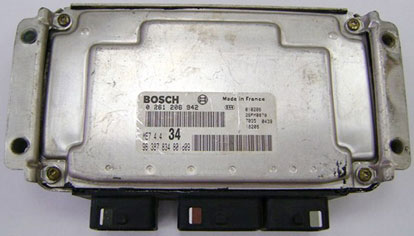
Citroen / Peugeot Bosch ME7.4.4 Engine ECU Repairs
Type: Bosch Engine Management Fits: Citroen / Peugeot Fuel: Petrol Ref: ECUT103250 Note:…
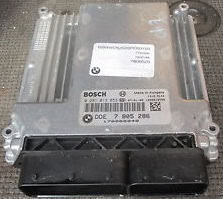
BMW 730d Intermittent Starting: How a Soak Test Found the Fault in Bosch ECU 0 281 013 500
The first bench test on this BMW 730d’s engine ECU…