
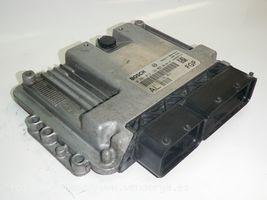
LDV Bosch EDC16C39 Engine ECU Repairs
Type: Bosch Engine Management Fits: LDV Fuel: Diesel Ref: ECUT75195 Note: This ECU may also fit other models. It is a Bosch Engine ECU and we are able to fully test and rebuild these units. Common part numbers
LDV’s diesel vans — the Convoy, the Maxus and the V80 — share one thing that shapes almost every engine ECU job we see from the marque: they run essentially a single Bosch engine-management platform, the EDC16C39 common-rail diesel unit. Because it is one well-understood design worked hard in a working vehicle, the failures that reach us are rarely the gradual electronic decay you might expect. More often the trigger is a discrete electrical event — a reverse-polarity connection, a jump-start spike, a flat battery caught on the wrong terminals — that puts an otherwise healthy unit down in a single instant.
That is the work covered here. We are a UK engine ECU repair specialist, and we repair the LDV EDC16C39 by finding and fixing the fault on the board rather than exchanging the module. This page sets out the LDV engine ECU we document, the faults that put one on the bench, how we confirm the ECU is genuinely the cause, and how to send a unit in. It sits above our LDV part-number pages, which are listed below.
Across the LDV van range the engine ECU we hold documented coverage for is a single platform, and we know it well:
We keep our claims to what we can stand behind. LDV is a single-platform make for us, so rather than list units we do not hold, the honest position is this: we repair LDV engine ECUs at component level, and where your unit is the documented EDC16C39 we can point you straight at it. If it is a different LDV engine ECU, that is still real component-level work our engineers do — our coverage spans a wide range of makes and control units — but the right step is to confirm your exact part number with us rather than assume it from the van’s model name. We would rather check than guess.
Because these vans earn their keep, the EDC16C39 tends to fail in ways tied to how the vehicle is used and maintained. The clearest example is a real one from our own bench: an LDV Maxus we rebuilt after a reverse-polarity spike. The battery terminals had been connected the wrong way round; the ECU was spiked and the engine would not crank or start. On our rig we confirmed the reverse-polarity damage, rebuilt the unit and it passed testing. It is a textbook case of the single-event failure this platform is prone to.
Beyond that, the faults we see inside these units fall into a recognisable set: damage following a voltage event such as a jump-start or spike, corrupted EEPROM memory, failed injector drivers, a failed voltage regulator, an internal relay or driver fault, and water ingress or corrosion where the unit has taken moisture on a hard-working van.
The way those faults show up at the vehicle is usually one or more of the following:
We never assume the ECU is at fault before it is tested. A fair number of units sent in as dead are actually reacting to something upstream — a corroded connector, a chafed harness, a tired sensor or a poor earth — and on a van that has covered serious mileage, wiring and connector condition matter as much as the module itself. After a suspected voltage event it is worth checking the charging and battery side too, since the same fault that spiked the ECU can still be present.
When a unit reaches us it is logged, visually inspected and electrically tested before any repair is proposed, then taken through fault-specific diagnostics to isolate the component that has actually failed. If the evidence points away from the ECU, we tell you, rather than carry out work that will not fix the van. Where the ECU genuinely is the cause, the component-level work is done under a microscope with temperature-controlled rework equipment, and nothing is signed off until the unit passes final testing.
Fixing the specific fault rather than swapping the module means the unit that goes back is the van’s own EDC16C39, with its original coding and immobiliser pairing intact. For an LDV that matters in practice: the repaired unit refits and runs with no dealer reprogramming and no re-marrying to the vehicle. On a single-event failure like the Maxus spike, that is often the most direct route to a running van — the original coding is preserved rather than rebuilt.
Every repair is carried out in-house by our own engineers, in our own UK workshop, using OEM-grade replacement parts that meet or exceed the original specification. The repair is tested before and after the work and is covered by a 24-month warranty on the specific repair carried out. Where a unit is documented as an exchange or repaired-and-returned item, it is handled on that basis.
We work entirely by post across the whole of the UK, so wherever the van is based you can send the unit to our workshop. To begin, complete the Repair Form on our contact page or call the workshop, and our engineers will confirm coverage for your unit and arrange a diagnosis and quote for the repair. Nothing chargeable starts until you have the outcome and have authorised the work. To see the wider range of engine ECUs we handle beyond LDV, our What We Repair section lists the makes and units we cover.

Type: Bosch Engine Management Fits: LDV Fuel: Diesel Ref: ECUT75195 Note: This ECU may also fit other models. It is a Bosch Engine ECU and we are able to fully test and rebuild these units. Common part numbers