
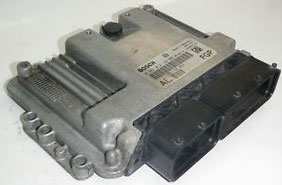
Saab Bosch EDC16C9 Engine ECU Repairs
Type: Bosch Engine Management Fits: Saab Fuel: Diesel Ref: ECUT151195 Note: This ECU may also fit other models. It is a Bosch Engine ECU and we are able to fully test and rebuild these units. Common part numbers
Saab is an unusual case among the makes we repair, because the manufacturer itself is gone. Saab Automobile ceased trading in 2011, so there is no factory and no dealer network left to supply a replacement engine ECU, recode a fresh unit to the car or pair it to the immobiliser. On a 9-3 or 9-5 diesel that fact changes the whole calculation: keeping the original coded ECU alive by repairing it at board level is not just the cheaper route, it is often the sanest way to keep an otherwise sound Saab running.
This is the hub for the Saab engine ECUs we hold in our library – all of them Bosch EDC common-rail diesel controllers from the later GM-era cars. Below you will find the specific units we repair, how these diesel ECUs tend to fail, how to tell the ECU apart from the sensors and wiring feeding it, and why repairing an orphaned marque’s own coded unit makes particular sense. We repair engine ECUs and nothing else – the controller that governs the diesel injection and engine management, not the peripheral modules around it.
Our Saab coverage is the Bosch EDC (Electronic Diesel Control) range – the common-rail diesel controllers fitted to the later 9-3 and 9-5 TiD and TTiD cars. There are three units in our library:
All three are Bosch EDC common-rail diesel units, and all three are repaired at component level in our own workshop rather than swapped for a substitute. Saab’s petrol cars ran a different system entirely – the Trionic engine management (T5, T7 and T8) – and our listed part-number coverage here is the Bosch EDC diesel range, not the petrol Trionic units. If your Saab runs one of the diesel controllers above, follow the relevant link for the unit detail; if you are not certain which ECU your car carries, our team will confirm the exact unit rather than guess before anything comes in.
These EDC controllers were sound designs, and they do not usually fail because the engineering was poor. They fail because electronic components age, and a common-rail diesel ECU works hard – it switches high-current injector and actuator loads every time the engine runs. The recurring culprits are the ones we see across ageing diesel ECUs: dry or cracked solder joints where years of thermal cycling have fatigued the board, failed injector-driver stages that can no longer switch the injectors cleanly, a failed voltage regulator, and corrupted memory where the ECU can no longer hold its stored data reliably.
On a 9-3 or 9-5 diesel that shows up as symptoms an owner will recognise. The car may crank but not start, cut out and refuse to restart until it has cooled, run rough, lose power or drop into limp mode, or throw injector-related fault codes that come and go. Because these are physical, age-driven faults on the board itself, they tend to worsen rather than settle – which is why a proper board-level diagnosis is worth doing before the car becomes undriveable.
Before a unit ever reaches us, it is worth ruling out the things around the ECU, because the controller often takes the blame for a fault that lies elsewhere. A diesel ECU depends on a healthy supply and clean signals: a weak battery or poor earth, corroded connector pins, a chafed or broken loom, a tired crank or cam sensor, or a fuel-rail pressure sensor giving bad readings can all produce symptoms that look exactly like a failing engine ECU.
A sensible sequence is to check the battery and earth feeds, inspect the ECU connector and the engine loom for corrosion and damage, and confirm the basic sensor signals before condemning the unit. If those check out and the fault still points at the controller – particularly an injector-driver fault or a temperature-sensitive fault that follows the ECU – then a board-level repair is the right route. When a unit reaches us it is logged, visually inspected, electrically tested and then taken through fault-specific diagnostics, so the actual fault is found rather than assumed.
The question owners ask is whether it is worth repairing the ECU at all rather than fitting another one. On a Saab the answer is usually yes, and the reason is specific to the marque. With no manufacturer and no dealer network behind the car, there is no factory route to supply a replacement engine ECU and code it to your vehicle. A used unit from a donor car is an unknown – you inherit its age and condition, and it still has to be married to your car’s immobiliser, which is exactly the kind of coding that has become awkward now Saab is gone.
Repairing the board sidesteps all of that. Our approach is component-level: we diagnose and repair the specific fault – the dry joint, the failed injector driver, the tired voltage regulator, the corrupted memory – rather than swapping the whole unit. That means the ECU keeps its original coding and immobiliser pairing and stays the unit that already belongs to your car, so there is nothing to recode and nothing to marry. Component-level work is carried out under a microscope with temperature-controlled rework equipment, and a repair is not signed off until the unit passes final testing. Every repair we carry out is backed by a 24-month warranty on the specific work done.
We are a mail-in engine ECU repair service covering the whole of the UK, run in-house by our own engineers on our own equipment – no outsourcing and no overseas processing. The process is straightforward and nothing chargeable begins without your say-so: your ECU is tested and diagnosed, you are contacted with the outcome and an estimate, and work only starts once you authorise it.
To get started, complete the Repair Form on our contact page and our engineers will confirm coverage for your exact unit and take you through the next steps. You can also read across our wider What We Repair range or browse the full engine ECU repairs library to check the unit in your car. If your Saab runs one of the Bosch EDC diesel controllers, start with the EDC16C9, EDC16C39 or EDC15M1 unit page, then send the ECU in.

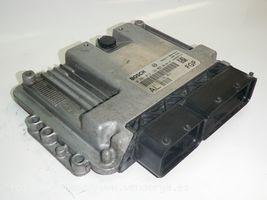
Type: Bosch Engine Management Fits: Saab Fuel: Diesel Ref: ECUT151195 Note: This ECU may also fit other models. It is a Bosch Engine ECU and we are able to fully test and rebuild these units. Common part numbers

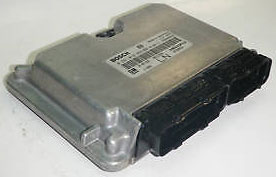
Type: Bosch Engine Management Fits: Saab Fuel: Diesel Ref: ECUT150295 Note: This ECU may also fit other models. It is a Bosch Engine ECU and we are able to fully test and rebuild these units. Common part numbers

Type: Bosch Engine Management Fits: Saab Fuel: Diesel Ref: ECUT149225 Note: This ECU may also fit other models. It is a Bosch Engine ECU and we are able to fully test and rebuild these units. Common part numbers