
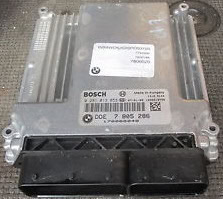
 The first bench test on this BMW 730d’s engine ECU found nothing wrong with it. The car had been suffering from intermittent starting, and an ECU that behaves itself on a short test can still be the cause. Below is the job as it ran: why testing continued, what the longer test turned up, and how the car ended up with a working ECU and no programming to do on the vehicle.
The job, stage by stage
The customer, in Bolton, Greater Manchester, posted the ECU to us from his 730d and reported intermittent starting issues. The unit was a Bosch EDC16CP35, part number 0 281 013 500, BMW number DDE 7803369. From there the job ran in five stages.
- Initial test. Our own engineers logged the unit in our UK workshop, inspected it visually and tested it electrically. No faults were found.
- Extensive soak test. A fault that comes and goes needs more than one pass, so the unit was kept running on the bench over an extended period. This time it triggered faults.
- Fault located. Fault-specific diagnostics traced those faults to the main processor.
- Verdict. The processor fault was irreparable, so the original unit could not be put back into service.
- Replacement. We offered the customer a replacement unit and transferred the coding from his original ECU into it, so no programming was required on the vehicle.
That last stage is what kept the outcome simple for the owner. Coding is what ties an engine ECU to the car it came from; carried across before the replacement left us, it meant the unit could be fitted without anyone programming it on the vehicle.
Why a clean first test did not close the case
An intermittent fault is intermittent on the bench as well as in the car. A short test sees the unit in one state, at one moment, and if the fault is not active in that window the ECU passes. A soak test gives the fault time to show itself. Had testing stopped at the first pass, the result would have been a clean report on a unit that was not healthy.
The opposite case matters just as much, and it is why testing always comes before any verdict. Intermittent starting on a 730d often has nothing to do with the ECU: low battery voltage, a poor supply to the unit or a bad connection can each give a car that starts one day and not the next. A clean result from a thorough test can send the search back to the car. On this job, the soak test placed it inside the unit.
Repair is always our first aim. We work at component level, tracing the specific part that has failed and replacing it so the original ECU goes back into the car. This job was the exception: the fault sat in the main processor, the chip that runs the unit’s control software, and on this unit it could not be repaired.
Where the 0 281 013 500 is fitted
The label carries two numbers: Bosch 0 281 013 500, also written 0281013500, and BMW’s DDE 7803369, which also appears as 7 803 369. This EDC16CP35 is recorded in the 730d of the E65 7 Series and in the 530d of the E60 and E61 5 Series, both running the M57N2 3.0-litre diesel.
The CP35 variant of Bosch’s EDC16 has its own page, listing this part number among others. If your label reads differently, look through BMW engine ECUs under other part numbers; if the car is not a BMW, go to engine ECUs from other manufacturers.
Reporting an intermittent fault when you send your ECU
Units come to us by post from anywhere in the UK. Each one is tested and diagnosed, then we contact you with the outcome and a quote, and no chargeable work begins without your authorisation. Repairs we carry out are covered by a 24-month warranty on the work done.
Contact us for a quote via the Repair Form. When you fill it in, tell us whether the fault comes and goes, how often the car fails to start, and anything already checked on the car, such as the battery and its connections. Add both label numbers, 0 281 013 500 and DDE 7803369. A fault described as intermittent tells us from the outset that one clean test will not settle the question.
Related Posts
Citroen / Peugeot Bosch MA3.1 Engine ECU Repairs
Type: Bosch Engine Management Fits: Citroen / Peugeot Fuel: Petrol Ref: ECUT94195 Note:…
Mercedes Bosch ME2.1 Engine ECU Repairs
Type: Bosch Engine Management Fits: Mercedes-Benz Fuel: Petrol Ref: ECUT77225 Note: This ECU…
VW / Audi / Seat / Skoda (VAG) Bosch M2.3 Engine ECU Repairs
Type: Bosch Engine Management Fits: VAG - Audi / Seat…