
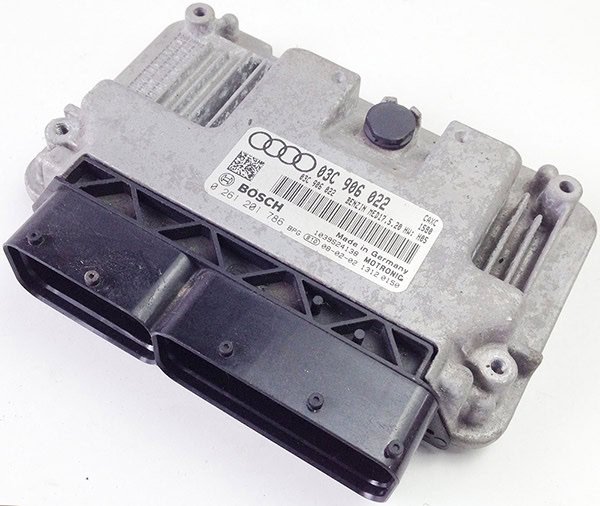
 On the Volkswagen Passat 1.4 TSI, Bosch number 0261 201 928 and VW number 03C 906 022 G identify a Bosch MED17.5.20 engine ECU. It is the unit that reads the accelerator pedal, which makes it capable of producing a fault code that names the pedal while the pedal itself is sound.
The accelerator on this car is not a mechanical linkage. It is a pair of sensors on one pedal, sending two separate signals down two circuits — deliberately, so that neither has to be believed on its own. The ECU reads both and compares them. Two signals that track one another as the pedal travels are credible; two that do not agree are not, and at that point the unit is built to stop acting on the pedal rather than choose between them.
That comparison is where the attribution goes wrong. The disagreement the unit reports is real; what the code cannot tell you is which end of the circuit produced it. An ECU that has lost the ability to read those two inputs correctly registers the same disagreement a failing pedal would, describes it in the same terms, and refuses the pedal in the same way. That is how a car ends up with no response from the accelerator and a pedal in good order.
That is what one of these units turned out to be. A 2009 Passat 1.4 TSi arrived with the engine light on permanently, a rough idle and no response from the accelerator. On our test bench, away from that car and its pedal, the unit failed the test cycle and presented two permanent fault codes:
- P2127 — Throttle / Pedal Position Sensor / Switch — Circuit Low Input
- P2138 — Voltage Correlation
With the test report agreed, two major components were replaced, the board reworked, and the unit re-tested to confirm it was fully functional before it went back.
None of that is an argument for suspecting the unit first. On this car a P2127 or a P2138 very often is the pedal sensor, or the connector and wiring between the pedal and the ECU, and that is where to begin: those parts are on the car and can be tested where it stands. The ECU earns suspicion at the other end of that process — once the pedal has been checked, the wiring proven, and the fault has stayed exactly where it was.
The other ways one of these fails are blunter. It is a direct-injection petrol unit — the D in MED is what separates it from Bosch’s ME designation — and across the MED17.5 family the patterns that recur are a non-start, an engine warning light, and misfires. Damage also arrives from outside the unit: connecting the battery the wrong way round can be enough on its own to finish one off.
Where the unit sits on this car matters too. It lives in the scuttle area under the windscreen, where rainwater is collected and led away, so what keeps it dry is a drainage path staying clear. Nobody inspects a drainage path. When one stops doing its job the water has to go somewhere, and the ECU is in the way.
A unit that reaches us is tested and diagnosed first. We come back to you with what has been found, and nothing chargeable begins without your authorisation. Where the fault is in the unit, it is repaired at component level on the board that came out of your car, and the job is not finished until it passes final testing. Your own ECU is what goes back, so the coding and pairing it already holds with the Passat stay untouched, and the repair carried out is covered by our 24-month warranty.
Every unit is handled here: our own UK workshop, our own equipment, our own engineers, nothing subcontracted and nothing sent overseas. Units reach us by post from across the UK, and from further afield. A separate page covers what we do with the Bosch MED17.5.20 itself, and the units we handle for other Volkswagens are gathered in our Volkswagen engine ECU repair section.
If a Passat 1.4 TSI has had a pedal fault diagnosed and the fault has outlived the pedal, send the unit in and have it tested. Complete the Repair Form.
Related Posts
Chrysler Voyager 2.5 CRD Voltage Fluctuating at Tickover: Bosch 0281010814 ECU Tested and Repaired
Nothing in the original complaint about this Chrysler Voyager 2.5…
Fiat Punto Magneti Marelli IAW 59F.M3 Engine ECU: Loss of Power Traced to Failed Ignition Coil Circuits (P0351, P0352)
Loss of power and poor running could have sent the…
BMW X3 2.0d That Would Not Rev: Two Faults in Its Bosch 0 281 013 501 ECU
Five volts should have been reaching the throttle position sensor.…