
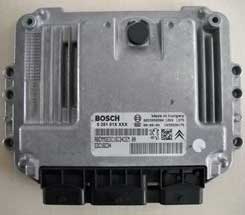
 The corrupted software in this Ford Fiesta 1.6 TDCi’s Bosch EDC16C34 engine ECU was not the first thing we put right. The hardware was. Failed components were replaced and the PCB reworked, and only then was the software reflashed and the unit retested.
Rough running and a car that would not start
The customer’s complaint was that the diesel Fiesta was running rough and would not start. They sent the engine ECU in to us for testing. Only the unit has to travel, wherever in the UK the customer is; the car stays put.
Rough running and a refusal to start can look like two unrelated faults. On this car, both led back to the engine ECU, or ECM. We can only speak for this unit. On another Fiesta with the same complaint the cause may lie outside the ECU altogether, and testing is what settles it.
Failed components and corrupted software in the same unit
Our process opens the same way for every unit: it is logged, inspected by eye and tested electrically, then diagnosed against the fault it came in with. When testing on this EDC16C34 was complete, we told the customer the unit was faulty and could be repaired. No chargeable work starts until a customer has that finding and has given the go-ahead.
The visual inspection showed that several components on the board had failed. The unit also had software corruption. Neither finding was the whole story on its own, so the repair had to deal with both, and it did so in a set order.
Why the board was repaired before the reflash
We replaced the failed components first, then reworked the PCB. Both are microscope jobs, carried out with temperature-controlled rework equipment.
With the hardware repaired, we reflashed the ECU’s software. Taking the steps in that order meant the software went onto a board that had already been repaired, rather than onto one still carrying failed parts.
It also meant that by the time the unit went back on test, both findings had been dealt with, so the result spoke for the whole repair rather than half of it.
A retest to confirm the repair had worked
The final step was that retest. Testing before the work had shown the unit was faulty; testing after it showed whether the repair had worked. A repair here is not complete until the unit passes final testing, and on this EDC16C34 the retest confirmed the repair had worked across the replaced components, the reworked PCB and the reflashed software.
The work is covered by our 24-month warranty on the repair carried out.
Checking the label on a 0281011612 unit
Bosch 0281011612 is an EDC16C34, and it is on record from both the Fiesta 1.6 TDCi and the Fusion 1.6 TDCi. Our table of every Ford EDC16C34 row we hold, this one included, lists it with the Ford number 5S6112A650GB and the code 4DWB.
The Ford number printed beside it is not always the same. 5S61-12A650-GB, usually with 4DWB, is the one most often printed with it, and 6S61-12A650-VC is also on record. On this unit, the Bosch number is the steady reference to quote.
If your Ford’s engine ECU carries a different number, look through other Fords and the engine ECUs they carry. If the car wears another badge, start from engine ECU repair for any make.
If your Fiesta or Fusion carries a 0281011612 unit and is showing faults of its own, use the Repair Form to tell us how the car runs, or whether it runs at all, then send the unit in for testing.
Related Posts
VW / Audi / Seat / Skoda (VAG) Bosch MA2.1 Engine ECU Repairs
Type: Bosch Engine Management Fits: VAG – Audi / Seat / Skoda…
Citroen / Peugeot Bosch MP7.3 Engine ECU Repairs
Type: Bosch Engine Management Fits: Citroen / Peugeot Fuel: Petrol Ref: ECUT102195 Note:…
From gas refill to leak repair: A Complete Guide to Car AC Repair
The purchase of a car is one's goal, and it…