
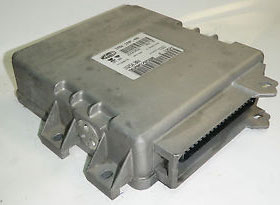
 Three separate faults were waiting inside the Magneti Marelli IAW 1AP.81 engine ECU from this petrol Citroën Saxo 1.4 8V: an immobiliser fault, dry joints and corrupted software. Putting right one or two of them could still have left the unit unable to do its job, so all three were repaired before it went back.
The page follows the job in order: why the ECU was suspected, what testing found and how each fault was dealt with.
No fuel-pump pulse and no spark: why the ECU was suspected
The customer had the car diagnosed after it failed to start. Diagnostics found no pulse to the fuel pump and no spark, so the engine was getting neither fuel nor ignition.
The wiring and relays tested okay. With those proven, the common factor left behind both missing signals was the engine ECU, and the auto electrician suspected a possible ECU fault. The customer sent the unit to us for independent testing and repair.
An immobiliser fault inside the engine ECU is one way a car can be left with neither fuel nor spark, as this Saxo was. Testing found one here, and two further faults alongside it.
Three faults in one Magneti Marelli IAW 1AP.81
With the ECU on our bench and away from the car, testing turned up three faults. There was a fault in the immobiliser circuit inside the unit. There were dry joints on the circuit board. And the ECU’s software was corrupted.
They are different kinds of fault: one in a circuit, one in the soldering, one in the software. Repairing any one of them does nothing for the other two, which is why the job could not stop at the first finding.
Every fault repaired before the unit went back
Any one of the three, left in place, could have kept this ECU from doing its job. So the whole unit was tested, and every fault found was dealt with before it went back.
The board came first. All of the old solder was removed and the board was re-worked with new solder. Work at this level is done under a microscope with temperature-controlled rework equipment.
The ECU was then reflashed and its software reloaded. The immobiliser circuit was repaired at component level.
Only then did the unit go through final testing, which it passed. A repair here is not complete until it does.
The ECU went back to the customer fully working, covered by our 24-month warranty on the repair carried out.
Because it was the customer’s own unit that was repaired, it kept its original coding and immobiliser pairing with the car. On a job where the immobiliser circuit was one of the faults, that is the point of repairing the original: the unit stays matched to the Saxo it came out of.
Reading IAW 1AP.81 on the label
This Saxo’s engine ECU was a Magneti Marelli IAW 1AP.81, one of the numbers in the Marelli 1AP family. The same IAW 1AP.81 number is also widely listed from the Peugeot 206 with the 1.4 engine, so it is the Marelli number on the label, not the badge on the car, that identifies the unit.
Copy the number exactly as printed, including the two digits after the dot. A different pair of digits means a different 1AP unit, and the Marelli 1AP family page is where those are covered.
Sending an IAW 1AP.81 in for testing
The service is mail-in only, open to senders anywhere in the UK. Each unit is logged, inspected and tested, and you hear what we found before any chargeable work begins.
If your car will not start and the checks so far point at the ECU, describe the no-start and what has already been tested on the Repair Form, with the full Marelli number from the label.
For a Citroën with a different unit fitted, see Citroën’s engine ECUs gathered in one place. Engine ECUs from cars that are not Citroëns are listed on our main hub.
Related Posts
Mercedes-Benz ML430 Bosch ECU 0261206303 With a Badly Soldered Chip and No Start
Our testing rig gave two verdicts on this Bosch engine…
Mercedes Vito 2.2L CDi (Bosch: 0281011066 – OEM: A611530291) ECU Repair
The customer reported that he was driving along when all…
Car Headlights Guide: How to Change a Car Headlight Bulb
Driving at night becomes a perilous chore that requires being…