
Once a garage tells you the engine ECU is the problem, the question you are left holding is not really a technical one. It is a choice between two routes — putting right the unit already on your car, or fitting a different one in its place — and they diverge in far more than price. One keeps the module your vehicle’s immobiliser already recognises. The other introduces a unit the car has never seen, which generally has to be programmed and paired before the engine will start at all. This guide sets out what each route involves, what drives the cost of each, and when replacement is genuinely the better answer.
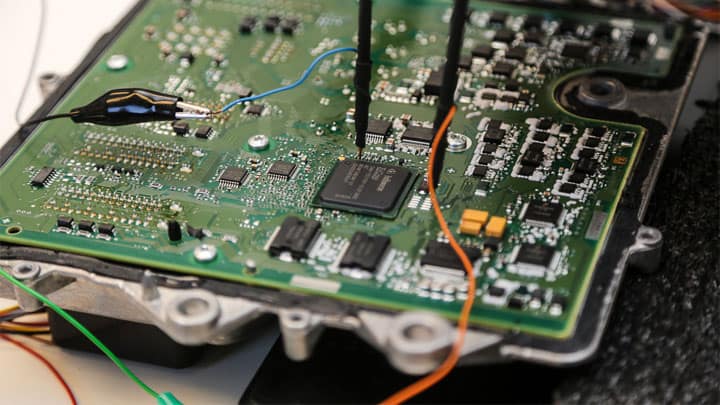
First, be sure the ECU is genuinely the fault
The ECU is one of the most over-blamed components on a modern car, and both routes below are expensive ways to answer the wrong question. There is an asymmetry worth understanding first. A repair specialist tests the unit and reports what has failed inside it, so a healthy ECU is identified as healthy. Fitting a replacement diagnoses nothing — it moves the old unit off the car and assumes. If the real fault was a sensor, an earth or a chafed loom, the symptom returns with a freshly coded module in the bay.
If the diagnosis is not yet confirmed, start there rather than here. We cover the symptoms of a failing ECM and how to separate them from the faults that mimic them, and go through common engine control unit problems in more depth. A faulty MAP sensor in particular produces ECU-shaped symptoms and fault codes while the module itself is sound.
Can a faulty ECU be repaired?
Yes — in most cases a faulty engine ECU can be repaired rather than replaced. Component-level repair means diagnosing the specific part that has failed on the circuit board and replacing that part, rather than discarding the whole unit. Because the board, the processor and the memory holding the vehicle’s coding are all retained, a properly repaired ECU goes back on the car without reprogramming.
That is the general case rather than a guarantee, and what decides it is what has actually failed. Most ECU failures are component failures: an injector driver that has gone down, a voltage regulator that has given up, solder joints cracked by repeated heat cycling, a corrupted memory chip. Each is one part on a board, and each can be replaced without disturbing the rest of the unit — including everything that makes it yours.
What replacing an ECU actually involves
Replacement sounds like the simpler route, because the word implies a part swap: off with the old, on with the new. On a modern vehicle it is rarely that, and the steps that make it more than that are where the route’s real cost and its real risk both sit.
Sourcing the right unit
Three kinds of unit are on offer and they are not interchangeable. A new unit from the manufacturer is the most straightforward and the most expensive. A remanufactured unit is an existing unit restored to working order, sometimes supplied pre-programmed. A used unit from a breaker is the cheapest and carries the most caveats, because it arrives configured for a different car and carries that car’s data rather than yours. On older or low-volume vehicles the question can settle itself: units go out of production, and a part that cannot be bought is not an option however well it suits the argument. Those three are what the general market offers; a replacement supplied by a specialist who already has your original unit in front of them works differently, and we return to that below.
Programming it to your vehicle
An engine ECU is not a generic box. The software it carries is matched to the engine variant, the transmission, the emissions specification and the market the vehicle was built for, and on most modern vehicles the unit also holds the vehicle’s own identity in the form of its VIN. A replacement therefore has to be programmed to your car’s specification before it will run correctly, and that is a separate operation from fitting it, generally needing manufacturer-level diagnostic equipment. It is the step most often left out when people cost up a replacement.
Pairing it to the immobiliser
Programming makes the unit right for the vehicle. Pairing makes the vehicle accept it. The immobiliser is a security relationship between the ECU, the key and, on many cars, a dedicated security module, and until the replacement is part of that relationship the engine will crank and refuse to fire. This is the most common reason a self-fitted replacement does not work, and it has nothing to do with the quality of the unit. Some manufacturers add a further layer, often described as component protection, which keeps the module inoperative until it is authorised through the manufacturer’s own system.
ECU repair vs replacement, compared
Set side by side, the two routes differ on far more than the bill.
| Factor | Repairing the original unit | Fitting a replacement unit |
|---|---|---|
| Coding and programming | Not needed. The unit keeps the software already on it and goes back as it came off. | Generally needed. The unit must be programmed to your vehicle’s specification before it will run correctly. |
| Immobiliser pairing | Retained. The vehicle already recognises the unit as its own. | Must be established. An unpaired unit will typically crank the engine but not start it. |
| What gets diagnosed | The component that failed is identified, so you learn what went wrong and why. | Nothing. If the ECU was not the cause, the symptom stays. |
| If the ECU was misdiagnosed | Testing shows the unit is healthy before any chargeable work begins. | You find out after the unit has been bought, fitted and coded. |
| Stored vehicle data | Untouched. The mileage and adaptation data are your car’s own. | A used unit carries the donor car’s data; some vehicles display its stored mileage if it is not correctly coded. |
| Older or rare vehicles | Not a factor. The unit is already in your hands. | Often the deciding problem. Units for older vehicles are frequently discontinued or hard to source. |
| Warranty | Our repairs carry a 24-month warranty on the work carried out. | Varies entirely with the supplier and whether the unit is new, remanufactured or used. A replacement supplied by us carries the same 24-month warranty as our repair work. |
| When it is the wrong choice | When the board is physically destroyed, corroded beyond reconstruction or security-locked. | When the ECU was never the fault, or when the original is straightforwardly repairable. |
What drives the cost of each route
This is the question the search results are loudest about and least useful on. The figures you will find are mostly quoted for other markets, other vehicles and other jobs, and a number accurate for one car tells you very little about another. What travels between vehicles is not the price. It is the structure of the price.
ECU repair is generally more cost-effective than outright replacement, and the reason becomes visible once the two are broken down rather than compared as headline figures. The repair route has two elements: identifying what failed, and putting that failure right. The replacement route carries neither of those in full, and adds three of its own — the unit itself, the programming and pairing, and the labour to fit and configure it. It is not that any one element is extravagant. It is that replacement is a longer bill by construction.
| Cost element | Repairing the original unit | Fitting a replacement unit |
|---|---|---|
| The unit | Nothing. You already own it. | The largest single element, varying most between new, remanufactured and used. |
| Diagnosis | Yes, and it is the core of the job. It establishes that the ECU is genuinely at fault. | Only whatever was done beforehand. The replacement itself establishes nothing. |
| Components | The specific parts that failed, usually a small fraction of the unit. | Not applicable. |
| Programming and coding | None. | Generally required, and usually charged separately from the unit. |
| Immobiliser pairing | None. It is already paired. | Generally required, and on some vehicles needs manufacturer-level access. |
| Fitting labour | Removal and refitting only. | Removal and refitting, plus the programming appointment. |
| The cost of getting it wrong | Low. A healthy unit is identified before you commit to anything. | The full cost of the unit and its coding, with the original symptom still present. |
Two things follow, and both are worth saying plainly. A repair price cannot honestly be published in advance: what it costs depends on which component has failed, and that is not known until the unit has been tested. A figure quoted before diagnosis is a guess wearing the clothes of a quote. And the cheapest-looking option on the replacement route, the used unit, is the one that most reliably collects the programming and pairing costs its price tag left out.
When replacement is genuinely the right answer
It would be convenient for us to argue that repair always wins. It does not, and the cases where it loses are worth knowing before you send anything anywhere.
- Physical destruction. A board that has been cracked, crushed, burned or had its connector torn out is not a repair candidate in any meaningful sense. There is no failed component to find, because the failure is the board.
- Water damage that has had time to work. Ingress on its own is often repairable and is a common cause of ECU failure, particularly in the UK climate. What cannot be repaired is corrosion left long enough to eat through tracks, pads and component legs. At that point the circuit is not faulty, it is missing.
- Components that no longer exist. Some parts on older units are obsolete with no functional equivalent. If the component that failed cannot be obtained, the repair route ends there however clean the diagnosis was.
- Security-locked units. A unit locked either deliberately or by a failed coding attempt may not be recoverable, and no board-level work changes that.
- Previous work done badly. A unit already opened and worked on poorly — lifted pads, bridged tracks, wrong components fitted — can be past the point where further repair is sensible.
Notice the pattern. Every one of those is a statement about the physical condition of the board, not about the symptom the car is showing. Which is precisely why this decision cannot be made from the driver’s seat, and why anyone offering a verdict before the unit has been opened is guessing.
Recognising yourself in that list does not leave you stranded, and it is worth saying where a unit in that condition actually goes. We stock replacements for some of the most common failing units — not a catalogue covering every make and model, but the units we see fail most often. Where testing shows a repair is not viable and we hold the right unit, that replacement carries the same 24-month warranty as the repair work does.
That is a different proposition from buying a replacement anywhere else, and the difference is the original unit. Everything described earlier — the sourcing, the programming, the immobiliser pairing — applies to a unit bought in from a dealer, a factor or a breaker, because nobody involved has your original to work from. Provided the coding data in the original ECU is intact, we can usually transfer that coding into the replacement, so it arrives ready to fit with no additional programming required. It is not a guarantee; it depends on the coding data having survived whatever killed the unit. But where it holds, it removes from the replacement route the same step a repair removes — and it is only possible because the original was sent in.
So we do not offer a replacement outright, and the recommendation does not change with the answer: send the original in to be tested first. Repair is almost always the more economical route, which is reason enough to rule it in or out before committing to anything else. And if testing rules it out, the unit you sent in is the thing that makes the alternative straightforward.
Having the unit tested before you commit
Both routes hinge on the same missing piece of information: what has actually failed inside the unit. A fault code read on the car cannot tell you, because codes describe circuits, not the module reading them. It takes testing the ECU itself, off the vehicle, where its inputs, outputs and supply rails can be exercised directly.
Engine ECUs, ECMs and PCMs are the whole of our remit — petrol, diesel, hybrid and direct injection — and nothing outside that box comes through the workshop. Repairs are carried out in our own UK workshop by engineers we employ, on our own equipment; nothing is subcontracted and nothing goes overseas. Coverage spans European, Japanese, Korean and American manufacturers, and the makes we repair are listed in full, though coverage for any particular unit is confirmed by our technical team rather than assumed.
It runs as a mail-in service wherever in the UK you are. The unit is booked in, tested and diagnosed first; you are then told what has failed and what the repair would come to, and nothing chargeable starts until you have agreed to it. If the answer is that the unit cannot sensibly be repaired, you are told that too — a clear no is more useful than a hopeful maybe. The work carries a 24-month warranty.
If you are weighing the two routes and want the diagnosis before committing to either, complete the Repair Form and our engineers will confirm coverage and diagnose your unit.
ECU replacement and repair: common questions
How much does it cost to replace an ECU?
There is no single figure, and any number quoted without seeing the vehicle is a guess. A replacement is not one cost but three: the unit itself, the programming and pairing needed to make it work on your car, and the labour to fit it. Each varies with the make, model and engine variant, and with whether the unit is new, remanufactured or used — which is why figures published online rarely translate to the car on your drive. Repair is quoted on the unit once it has been tested, on application rather than as a headline price, because the fault decides the figure.
Is it worth replacing an ECU?
It is worth replacing when the unit genuinely cannot be repaired: a physically destroyed board, corrosion that has gone through the tracks beyond reconstruction, or a unit locked in a way that cannot be recovered. Outside those cases, replacement asks you to buy a unit and pay to programme it in order to solve a problem a component-level repair addresses on the unit you already own, with its coding intact. The prior question matters more than either: confirm the ECU is actually at fault, because a replacement fixes nothing if the cause was a sensor or a wiring problem.
Do you supply replacement ECUs?
Not as an opening offer, and not for every unit. We stock replacements for some of the most common failing units, and where testing shows the original cannot sensibly be repaired, a replacement is the fallback — carrying the same 24-month warranty as the repair work does. What we do not do is sell you one instead of testing what you have, because repair is almost always the more economical route and there is no way to know which applies until the unit has been tested. Send the original in first: if its coding data is intact we can usually transfer that coding into the replacement, so it arrives needing no additional programming.
Can I replace my ECU myself?
Removing and refitting the unit is often within reach of a competent home mechanic, since it is usually a connector or two and a few bolts. The part that generally is not is the programming and immobiliser pairing a replacement needs before the engine will run, which typically requires manufacturer-level diagnostic equipment and access. A unit fitted but not coded will commonly crank without starting. That is why a straight swap is rarely the job it appears to be.
Will a repaired ECU need coding when it comes back?
No. A component-level repair replaces the failed part and leaves the unit’s software, configuration and immobiliser pairing exactly as they were, so it refits to the vehicle it came off without any programming step. This is the clearest practical difference between the two routes: it removes an entire stage from the job rather than just shortening it.
What happens if a replacement ECU is not coded to the vehicle?
On most modern vehicles the engine will crank but not start, because the immobiliser does not recognise the unit and will not authorise it. Depending on the vehicle you may also see incorrect data displayed, as a unit taken from another car can bring its donor’s stored mileage to your instrument cluster. Coding is not a finishing touch on the replacement route; it is what makes the unit work at all.
Is a second-hand ECU from a breaker’s yard a good idea?
It is the route that most often disappoints. A used unit carries the identity and configuration of the car it came out of rather than yours, so it generally needs programming to your vehicle’s specification and pairing to your immobiliser before it will run — steps easy to overlook when setting its price against a repair. You are also taking on an unknown, because the donor unit has seen the same age, heat and vibration as the one you are removing, and nobody has tested it.
Can I still drive with a faulty ECU?
It is not advisable. A unit mismanaging fuelling or ignition can cut power or stall the engine without warning, which is a safety problem in traffic before it is a mechanical one. If the car has dropped into limp mode, it is telling you the same thing in its own way.
How do I find out whether my ECU can be repaired?
By having the unit tested. Whether a fault is repairable is decided by what has failed and where on the board it sits, and neither can be established from the symptoms or from codes read on the vehicle, which describe circuits rather than the module. Testing the unit off the car identifies the failed component and answers the question directly, which is why it is the sensible first step whichever route you expect to take.
Related Posts
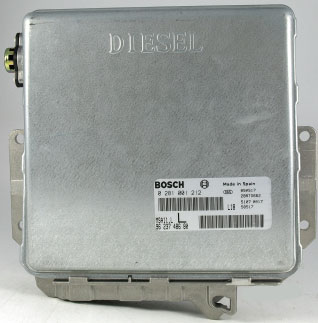
Citroen / Peugeot Bosch EDC 1.3.8 Engine ECU Repairs
Type: Bosch Engine Management Fits: Citroen / Peugeot Fuel: Diesel Ref: ECUT111250 Note:…
Saab Bosch EDC15M1 Engine ECU Repairs
Type: Bosch Engine Management Fits: Saab Fuel: Diesel Ref: ECUT149225 Note: This ECU…

Types of Immobiliser Systems: How They Work and Common Faults
Car immobiliser systems fall into a handful of families —…