
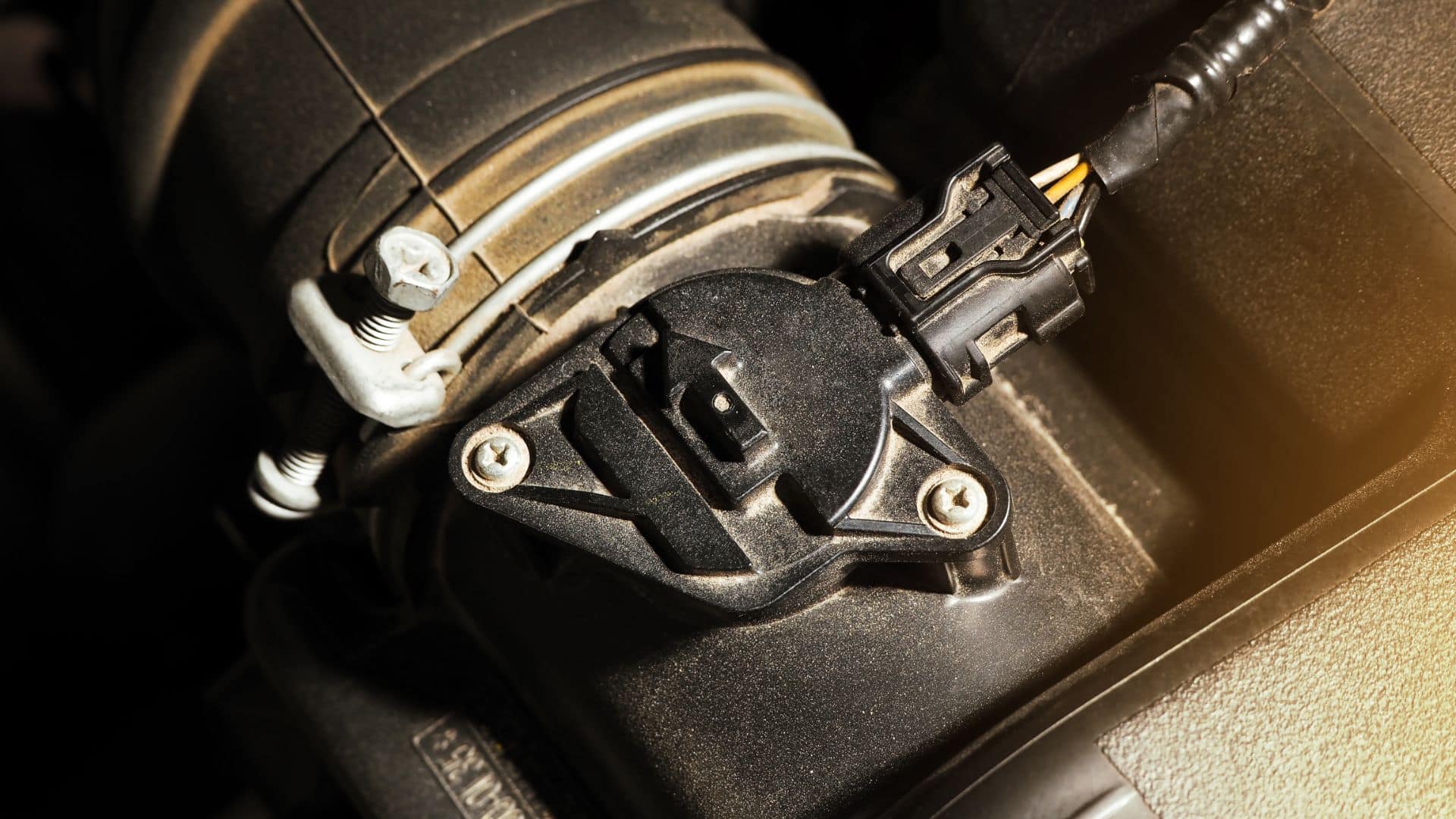
Every time you touch the throttle, the engine’s fuelling has to change within milliseconds, and the manifold absolute pressure (MAP) sensor is one of the few inputs that tells the engine management system how hard the engine is actually working. When it starts reading wrong, nothing fails outright. The engine simply runs badly, in ways that are easy to blame on something else. This guide covers the symptoms of a faulty MAP sensor, the P0105 to P0109 fault codes that arrive with them, how to test the sensor yourself, and how to tell a genuinely failed sensor apart from the vacuum, wiring and ECU-side faults that produce identical codes.
What a MAP sensor does, and why the ECU depends on it
The MAP sensor measures absolute pressure inside the intake manifold. Not pressure relative to the air outside, but the true pressure in the manifold, measured against a sealed vacuum reference inside the sensor itself. That reading is a direct proxy for engine load. At idle with the throttle closed, manifold pressure is low and vacuum is high. Under full throttle it climbs towards atmospheric pressure, and on a turbocharged engine it goes well above it.
The data collected by the MAP sensor is then sent to the engine control unit (ECU), which uses it to work out how much air is actually entering the cylinders, and therefore how much fuel each injector should deliver and when the spark should fire. Get that pressure reading wrong and every downstream decision is wrong with it.
Three wires do the job. A 5V reference supplied by the ECU, a sensor ground, and a signal wire that returns a voltage proportional to pressure. That detail matters more than it looks, and we come back to it later, because two of those three wires originate inside the ECU.
Faulty MAP sensor symptoms
A MAP sensor rarely dies cleanly. It drifts, and the engine management system quietly fuels to a number that is no longer true. Which symptoms you get depends on which way it drifts: reading high makes the ECU think the engine is working harder than it is, so it over-fuels; reading low does the opposite.
Check engine light
Usually the first sign, and often the only one at the start. The ECU monitors the MAP signal against what it expects from engine speed and throttle position, and lights the lamp when the two stop agreeing. The stored code will normally be one of P0105 to P0109, which narrows things down considerably before you have touched a spanner.
Power loss and limp mode
When the ECU cannot trust the load signal, it stops taking chances. Fuelling and timing default to a conservative map, and on many vehicles the car drops into limp mode outright. You get sluggish acceleration, poor throttle response and a car that will not pull past a certain point. On turbocharged engines this is one of the most common presentations.
Rough idling and stalling
Idle is where a small pressure error does the most damage, because at idle the fuelling margins are tightest. The engine hunts up and down, shakes, or cuts out as you come to a junction. Worth knowing before you order a sensor: rough idle with a MAP code is at least as often a vacuum leak as a failed sensor. The sensor is reporting a manifold pressure that is genuinely wrong, because air is getting in where it should not.
Heavy fuel consumption and black smoke
A sensor reading high tells the ECU the engine is under load when it is not, so it delivers fuel for work the engine is not doing. Fuel consumption climbs, you may smell unburnt fuel, and on a diesel in particular the excess shows as black smoke from the exhaust. Sustained rich running also loads the catalytic converter with fuel it was never meant to deal with, which is why this is worth chasing rather than tolerating.
Hesitation, flat spots and pinking
The opposite drift. A sensor reading low leaves the ECU under-fuelling and over-advancing the ignition for the load actually being asked of the engine. You feel it as a flat spot when you accelerate, hesitation on pull-away, sometimes a stumble that clears as revs rise. Lean mixtures burn hotter and can bring on detonation, the metallic pinking you hear under load, which is the part of this symptom set that does real mechanical harm if it is left.
Hard starting
At key-on, before the engine turns, the ECU reads the MAP sensor to establish atmospheric pressure and set its starting fuelling from it. A sensor that is lying at that moment gives the engine the wrong mixture to start on, so it cranks longer than it should, particularly from cold.
Failed emissions test
Both drift directions push emissions the wrong way, rich running most obviously. A car that sails through its MOT emissions check one year and fails the next, with no other change, is worth scanning for MAP codes before anything more expensive is considered.
MAP sensor symptom diagnostic table
Symptoms alone will not tell you which side of the circuit has failed. This is how to move from what you are seeing to what you should check, and where the fault is likely to sit.
| Symptom | What it usually means | How to confirm it | Sensor-side or ECU-side |
|---|---|---|---|
| Check engine light, P0106, car drives normally | Sensor has drifted slightly out of the expected range | Compare MAP against BARO in live data at key-on, engine off. They should read within a few kPa of each other | Sensor-side, usually |
| Rough idle, hunting, stalling at junctions | The ECU is fuelling to a manifold pressure that is real but wrong. Most often a vacuum leak, not the sensor | Smoke-test the intake. Check the MAP hose and manifold port for splits, perishing or carbon blockage | Neither. Usually the intake |
| Power loss or limp mode under load | The ECU cannot trust the load signal and has defaulted to a safe map | Watch MAP live data through a road test. Look for flatlines, spikes or a signal that stops tracking throttle | Sensor-side, or a genuine boost fault on turbo engines |
| Black smoke, heavy fuel use, smell of fuel | MAP reading high, so the ECU is over-fuelling for load that is not there | Check MAP at idle. It should sit well below atmospheric pressure, not near it | Sensor-side |
| Hesitation, flat spot, pinking under load | MAP reading low, so the ECU is under-fuelling and over-advancing | Compare MAP against throttle position in live data. The two should rise together | Sensor-side |
| Long cranking, worst from cold | Wrong pressure reading at key-on gives the wrong start-up fuelling | Read MAP at key-on before cranking. It should equal atmospheric pressure | Sensor-side |
| Same MAP code returns after a new sensor is fitted | The fault was never in the sensor | Back-probe the connector: is the 5V reference present, is the ground clean, does the signal move with vacuum? | Wiring, or ECU-side |
| MAP code arrives alongside throttle position or other sensor codes at once | The shared 5V reference feeding several sensors has collapsed | Measure the 5V reference at two or three different sensors on the same circuit | ECU-side, supply rail |
MAP sensor fault codes: P0105 to P0109 explained
These are the generic OBD-II codes for the MAP circuit. Read carefully, they tell you a good deal about where to look, because they describe the electrical behaviour of the signal rather than naming a broken part. Not one of them says the sensor is faulty. They say the circuit is.
| Code | Official description | What it means in practice |
|---|---|---|
| P0105 | Manifold absolute pressure / barometric pressure circuit malfunction | The ECU is not getting a usable signal at all. Typically an open circuit, a disconnected or dead sensor, or a failed supply to it. |
| P0106 | Manifold absolute pressure / barometric pressure circuit range or performance problem | A signal is present and looks plausible, but it does not match what the ECU expects from engine speed and throttle. The classic vacuum leak or drifted sensor code, and the most commonly misdiagnosed of the five. |
| P0107 | Manifold absolute pressure / barometric pressure circuit low input | Signal voltage is below the valid range. A short to ground, a broken 5V feed, or a sensor that is unplugged. |
| P0108 | Manifold absolute pressure / barometric pressure circuit high input | Signal voltage is above the valid range. A short to power, an open ground, or on a hose-fed sensor a blocked or disconnected vacuum feed, which leaves it reading atmospheric pressure permanently. |
| P0109 | Manifold absolute pressure / barometric pressure circuit intermittent | The signal drops in and out. Chafed wiring, a corroded or spread connector pin, or a joint that only fails when warm. The hardest of the five to catch, because the car will often behave perfectly while you are testing it. |
P0107 and P0108 are the two worth pausing on, because they are the codes people most often answer by fitting a sensor. Both describe a signal voltage stuck at one extreme, and a signal wire pinned at 0V or at 5V is at least as likely to be a wiring fault or a supply fault as a dead sensor.
How to test a MAP sensor
You can get a long way with a scan tool alone, and further with a multimeter and a hand vacuum pump. Exact voltage and pressure figures vary by manufacturer and by sensor type, so check the values in the vehicle’s service data before condemning anything. The tests below are about the pattern of behaviour, which is what actually tells you whether the sensor is honest.
1. Read the codes before you touch anything
Pull the stored codes with an OBD-II scanner and write down everything, not just the MAP code. What else is stored alongside it is one of the most useful pieces of evidence you will get, and it is the piece most people throw away by clearing the codes first.
2. The key-on barometric check
This is the single best test, it takes thirty seconds, and it needs nothing but a scan tool. With the ignition on and the engine not running, the manifold is at atmospheric pressure, so the MAP sensor must read atmospheric pressure. At sea level that is around 101 kPa, a little lower the higher above sea level you are. If the vehicle reports a separate barometric pressure reading, the two should agree closely. A MAP sensor reading 60 kPa with the engine off is lying, and you have found your fault without a single tool coming out of the boot.
3. Check it at idle, then snap the throttle
Start the engine and watch MAP in live data. On a naturally aspirated petrol engine, idle vacuum typically pulls the reading down to somewhere around 30 to 35 kPa. The number matters less than the movement: it should drop sharply and settle smoothly. Snap the throttle and it should rise towards atmospheric almost instantly, then fall away again on overrun. A reading that lags, sticks, jumps in steps or never moves has failed the test regardless of what the figure says.
4. Test the circuit with a multimeter
Back-probe the connector with the sensor still plugged in, because a voltage measured on a disconnected plug tells you nothing about how the circuit behaves under load. Check the three wires in turn: the reference wire should sit at close to 5V, the ground should show almost no voltage drop back to battery negative, and the signal wire should sit high with the ignition on and engine off, falling as vacuum builds at idle. This is where the diagnosis either stays with the sensor or moves upstream of it.
5. The vacuum pump test
For a sensor fed by a hose, apply vacuum with a hand pump while watching the signal voltage or the live data reading. It should fall smoothly and proportionally as vacuum increases, and hold steady when you stop pumping. If the reading moves in steps, wanders while the vacuum is held, or does not respond at all, the sensor has failed internally. If the pump will not hold vacuum, the sensor’s diaphragm has split, which is its own answer.
6. Look at the port before you blame the sensor
A MAP sensor cannot report a pressure it is not exposed to. On engines that see a lot of oil vapour or exhaust gas recirculation, the manifold port or the hose feeding the sensor carbons up until the pressure signal is damped or blocked entirely. A blocked port produces a sensor reading that is stuck near atmospheric, looks exactly like a dead sensor, and is cured with a cleaning rather than a component.
Will cleaning a MAP sensor fix it?
Sometimes, and it is worth doing before anything else because it costs nothing but time. Contamination on the sensing element, oil mist, carbon or fuel varnish, insulates it from the pressure it is meant to measure and makes a healthy sensor read slowly or low. A careful clean with an electronics-safe cleaner, sprayed rather than scrubbed and allowed to dry fully, will restore a contaminated sensor. It will do nothing for one that has failed electrically, and nothing at all for a wiring or supply fault, so retest afterwards rather than assuming.
When it is not the sensor: the ECU side of the circuit
Start from the honest position, because it is the one that gets you to the right answer fastest. Most MAP codes are not the ECU. In rough order of likelihood, a P0105 to P0109 is caused by the sensor itself having drifted or failed, a vacuum leak somewhere in the intake, a blocked or carboned manifold port or hose, or damaged, chafed and corroded wiring between the sensor and the ECU. Those four account for the overwhelming majority.
There is a fifth that deserves its own line: on a boosted engine, the sensor may be telling the truth. A P0106 on a turbo diesel can mean the pressure genuinely is out of range and the sensor is doing its job accurately, reporting a split intercooler hose, a sticking variable-vane actuator or a blocked filter. Replacing an honest sensor because you did not like its message is a well-travelled dead end.
Only once those have been eliminated is the ECU side worth looking at. It is the least likely cause on the list, and it needs saying plainly rather than buried, because the temptation in an article like this one is to point everything at the service we happen to provide. But it is a real cause, and it is the one that gets missed, for a simple reason: the code names the MAP circuit, and the MAP circuit is where everybody looks.
Two of the sensor’s three wires start inside the ECU. The 5V reference is generated by a regulator on the ECU’s own board, and the signal wire lands on an analogue-to-digital converter input inside it. If the regulator’s output sags, or that ADC channel fails, the ECU will report a MAP fault with a perfectly good sensor bolted to the manifold, and no number of replacement sensors will clear it. This is how a car ends up on its second or third MAP sensor with the same code still stored.
There is a tell worth knowing. That 5V reference is usually shared across several sensors on the same circuit, so if the rail itself collapses you will not normally see a lone MAP code. You will see MAP, throttle position and other pressure or position sensor codes appear together, all at once, on a car that was fine yesterday. A cluster of unrelated 5V-sensor codes arriving simultaneously points at the supply feeding them, not at any one sensor. A single MAP code, by contrast, almost always means the MAP circuit itself, and that is where your time is best spent.
If the trail runs past the sensor, past the hose and past the wiring, and starts pointing at the module itself, that is a different diagnostic job with its own symptom set. We have covered it separately in our guide to the symptoms of a failing ECM, which is the better place to start if the picture has moved beyond one sensor circuit.
Confirming an ECU-side fault properly means testing the unit off the car, on a bench, where the reference rail and the analogue inputs can be measured directly under realistic conditions rather than inferred from the vehicle’s own codes. That is the work we do: engine ECUs, ECMs and PCMs only, repaired down to component level on our own benches by our own engineers here in the UK, with no part of the job sent anywhere else. Coverage runs across European, Japanese, Korean and American makes, and you can see the makes we cover, though our technical team confirms a specific unit rather than guessing at it.
Because the repair addresses the component that has actually failed instead of swapping the box, the unit keeps the programming and immobiliser data already on it. It comes back still paired to your vehicle and refits without coding. It runs as a mail-in service, UK-wide: the unit is tested and diagnosed first, you are told what has failed and what putting it right would involve, and nothing chargeable begins without your say-so. Whatever we repair is covered for 24 months.
If your diagnosis has run out of road at the sensor and the evidence has moved to the module behind it, complete the Repair Form and our engineers will confirm coverage and diagnose the unit.
Frequently asked questions
What happens if a MAP sensor is bad?
The ECU fuels the engine for a load that is not real. Depending on which way the sensor’s reading has drifted, you get either over-fuelling, which shows as heavy fuel consumption, black smoke and a smell of unburnt fuel, or under-fuelling, which shows as hesitation, flat spots and pinking under load. A check engine light with a P0105 to P0109 code is usually stored alongside, and many vehicles will drop into limp mode rather than risk running on a signal they cannot trust.
How do I check if a MAP sensor is working properly?
The quickest reliable test needs only a scan tool. With the ignition on and the engine off, the MAP sensor must read atmospheric pressure, around 101 kPa at sea level, because the manifold is open to the outside air. If it reads anything well below that, the sensor is wrong. Then start the engine and watch the reading fall as vacuum builds, and snap the throttle to check it responds instantly and smoothly. A sensor that sticks, lags or moves in steps has failed even if the numbers look roughly right.
Will cleaning a MAP sensor fix it?
It will if the problem is contamination. Oil mist, carbon and fuel varnish build up on the sensing element and insulate it from the pressure it is supposed to measure, and an electronics-safe cleaner sprayed on gently and left to dry fully will restore it. Cleaning will not fix a sensor that has failed electrically, and it will do nothing for a vacuum leak, a blocked port or a wiring fault, so always retest afterwards rather than assuming it worked.
Can you drive with a faulty MAP sensor?
It is not a good idea. Beyond the poor running and the fuel consumption, the two failure directions each carry their own risk: sustained rich running loads the catalytic converter with unburnt fuel, and lean running with over-advanced ignition can bring on detonation, which damages pistons and bearings over time. If the car has dropped into limp mode it is also unlikely to behave predictably when you need it to.
What are the MAP sensor symptoms on a diesel?
On a turbo diesel the MAP sensor is generally reading boost pressure, so the symptoms tilt towards boost-related complaints: limp mode, a clear loss of power under load, black smoke, and often EGR-related codes stored at the same time. The important difference from a petrol engine is that a MAP code on a diesel is more likely to be the sensor accurately reporting a real boost problem, such as a split intercooler hose or a sticking turbo actuator, so check the boost system before condemning the sensor.
Can a faulty ECU cause MAP sensor fault codes?
Yes, though it is the least likely cause and should be the last one you investigate. The ECU supplies the sensor’s 5V reference and reads its signal on an internal analogue-to-digital input, so a failure on either can set a MAP code with a perfectly healthy sensor fitted. The usual clue is a MAP code arriving at the same time as throttle position or other sensor codes, which points to a collapsed shared 5V supply rather than any one sensor. Check the sensor, the vacuum system and the wiring first.
What is the difference between a MAP sensor and a MAF sensor?
They answer the same question by different routes. A MAF sensor measures the mass of air flowing into the engine directly, at the intake. A MAP sensor measures pressure in the manifold and lets the ECU calculate airflow from that, along with engine speed and air temperature. Some engines use one, some use the other, and many use both. It is worth confirming which your engine has before you start diagnosing, because the two are often confused and the tests are not interchangeable.
Does a new MAP sensor need coding to the car?
In the overwhelming majority of cases, no. A MAP sensor is an analogue device, and the ECU simply reads the voltage it returns, so a replacement generally works as soon as it is plugged in. You will normally want to clear the stored codes afterwards and then road-test the car to confirm the fault has genuinely gone rather than just the light.
Related Posts
Ford Visteon EECV LP2-110 Engine ECU Repairs
Type: Visteon Engine Management Fits: Ford Engines: Year: Fuel: Petrol Ref: ECUT39175 Note:…
Mercedes Bosch EDC15C6 Engine ECU Repairs
Type: Bosch Engine Management Fits: Mercedes-Benz Fuel: Diesel Ref: ECUT81250 Note: This ECU…
VW / Audi / Seat / Skoda (VAG) Bosch ME7.5.10 Engine ECU Repairs
Type: Bosch Engine Management Fits: VAG – Audi / Seat / Skoda…