
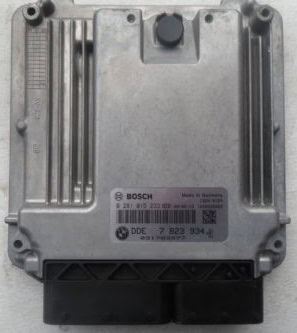
 Five volts should have been reaching the throttle position sensor. On our simulation test rig, the Bosch EDC16C35 engine ECU from this BMW X3 2.0d, part number 0 281 013 501, was supplying 0.6 V.
That was one of two faults the rig found in the same unit. What follows is the job as it happened: what the car was doing, what the testing showed, how the ECU was repaired and proved, and which other BMWs carry the same part number.
The X3 started, but it would not rev
The complaint was a frustrating one: the X3 would start, but it would not rev, so it could not be driven. After diagnostics on the customer’s side, the ECU was the suspect, and the unit was sent to us for testing and repair.
A diesel that starts but will not rev can have more than one cause, and a suspect is not yet a verdict. So the first step was to test the ECU on its own, where anything we found would belong to the unit and not to the car around it.
What the rig measured against what it should have read
Our purpose-built simulation rigs run an ECU as though it were fitted and running on the vehicle, so each signal it handles can be read and set against the value it ought to have. This unit fell short in two places:
- Throttle position sensor supply: the ECU was giving the sensor 0.6 V where it should supply 5 V.
- Ambient pressure: the sensor was reporting 1013 mbar through the ECU, but the ECU was recording only 800 mbar.
The sensor’s figure was the believable one: 1013 mbar is standard atmospheric pressure. The shortfall lay between the reading arriving at the ECU and the ECU recording it.
Finding both mattered. Had the testing stopped once the first fault turned up, the second would have gone back into the X3 inside a unit described as repaired.
Reworking the board, then a second pass on the rig
We reworked the circuit board and replaced the faulty components with new genuine parts. The work was done at component level, under a microscope with temperature-controlled rework equipment, so the customer’s original ECU was repaired rather than exchanged.
The ECU then went back on the rig and passed a second time. The first test had shown what was wrong; the second showed it had been put right, against the same checks, before the car was asked to depend on it.
It was returned to the customer fully working, with our 24-month warranty covering the repair carried out.
The same 0 281 013 501 in other BMWs
The Bosch number 0 281 013 501 pairs with BMW’s own reference, DDE 7803373. This unit came out of an X3 E83 2.0d, and the same reference is also recorded in the 320d (E90/E91), the 120d (E87) and the 520d (E60/E61).
If your ECU’s label shows either number, it is the same part as the one repaired here. That does not mean it has the same faults. It means the same testing applies, and that a car which starts but will not rev deserves a measured answer before the ECU is written off.
For more on the Bosch diesel ECU behind this job, see the EDC16C35 family this unit belongs to.
Sending an X3 2.0d engine ECU to us
We work by post and take units in from anywhere in the UK. Every ECU is repaired in-house by our own engineers, in our own UK workshop, and each one is tested before any repair is proposed. We then contact you with what we found and a quote, and no chargeable work starts until you authorise it.
To begin, tell us how the car behaves on the Repair Form, together with the numbers from the ECU label, and our engineers will confirm the unit before it is posted.
If your BMW has a different engine ECU, see BMW engine ECUs beyond this X3. For any other car, browse the full list of makes we work on.
2 Replies to “BMW X3 2.0d That Would Not Rev: Two Faults in Its Bosch 0 281 013 501 ECU”
Leave a Reply
Related Posts
BMW 320d Would Not Restart: Bosch 0 281 012 754 ECU Beyond Repair, Replaced With Coding Transferred
This BMW 320d had been driving normally until its owner…
BMW 730d Intermittent Starting: How a Soak Test Found the Fault in Bosch ECU 0 281 013 500
The first bench test on this BMW 730d’s engine ECU…
Fiat Punto (Magneti Marelli: IAW 59F.M3) Engine ECU Replacement
Customer has a Fiat Punto with a missfire on cylinder…
Hi we have a BMW Z4 in with us with ambient pressure sensor fault, Would you be able to replace ambient pressure sensor in ECU (reg number is bg64lxx) Part number of ECU 863172701
Hey Andy!
Thanks for reaching out.
Our sales department will be getting in touch with you soon regarding your enquiry.
Regards
ECU Repairs