
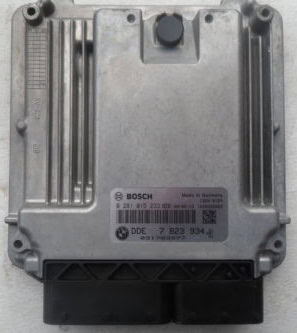
 This BMW 320d had been driving normally until its owner stopped at some shops. When he came back to it, the car would not start. Below is how that fault was traced to the engine ECU, what we found when the unit reached our bench, and how the car got a working ECU back with no programming needed on the vehicle.
Fine on the way in, dead on the way out
Nothing on the drive had given any warning. The car was parked, and on return it simply would not start. His local garage tried a jump start, which did not work, and their further diagnostics pointed to a possible fault in the engine ECU.
That word ‘possible’ matters. A 320d that will not start can have several causes: a supply or earth problem at the ECU, lost communication on the vehicle’s data bus, a relay or wiring fault, or the ECU itself. Diagnostics on the car narrow the list, but they cannot see inside the unit, so the ECU was posted to us to be tested before anything was condemned.
What testing found inside the Bosch EDC16C35
The unit was a Bosch EDC16C35, part number 0 281 012 754. Like every ECU that reaches our workshop, it was logged, visually inspected and electrically tested by our own engineers before fault-specific diagnostics began.
The damage was extensive, and it was beyond repair. That is not the result we set out to reach. Our work is at component level: we find the specific part that has failed, such as an injector driver, a voltage regulator or a CAN bus transceiver, and replace it so the original unit goes back into the car. On this board the damage went further than any such repair could put right.
A replacement unit that needed no programming on the car
We contacted the customer with the result and offered a replacement unit. An engine ECU is not a simple like-for-like exchange, though. The original carries coding that matches it to that particular car, and a replacement without that coding would leave programming to be done on the vehicle.
So before the replacement left us, we transferred the coding from the original unit to it. That made it plug and play: it could go straight into the 320d, and no further programming was needed on the car.
Is your 320d fitted with the same unit?
The ECU label answers that. This unit carries Bosch part number 0 281 012 754 and BMW number DDE 7799855, which also appears written as 7 799 855. It is recorded in the 320d in its E90 and E91 forms, and the same reference is also recorded in the 120d (E87) and the 520d (E60/E61).
Our page on the EDC16C35 in more detail covers the unit family as a whole. If the label on your BMW shows a different number, look up whichever BMW engine ECU you have; if the car is not a BMW at all, start with makes other than BMW.
Sending a BMW engine ECU to us for testing
Repair is always what we aim for first. This 320d was the exception, where the board had gone past it. The process is the same whichever way a job ends: the unit is posted to our UK workshop from anywhere in the country, tested and diagnosed, and we come back to you with the outcome and a quote. No chargeable work begins without your authorisation, and repairs we carry out are covered by a 24-month warranty on the work done.
Contact us for a quote via the Repair Form. Complete it before the unit goes in the post, and include both label numbers, 0 281 012 754 and DDE 7799855, with a short account of what the car did: when it stopped starting, whether a jump start was tried, and what the garage’s diagnostics showed.
Related Posts

Ford Fiesta 1.25 Petrol That Would Not Crank After Two Months Standing: Its Siemens SIM210 ECU (6S61-12A650-FD) Had Been Spiked
The Siemens SIM210 engine ECU from this petrol Ford Fiesta…
Chrysler Voyager 2.5 CRD Voltage Fluctuating at Tickover: Bosch 0281010814 ECU Tested and Repaired
Nothing in the original complaint about this Chrysler Voyager 2.5…
Ford Fiesta 1.6 TDCi Bosch EDC16C34 (0281011612) ECU Repair: Failed Components and Corrupted Software on a Rough-Running Non-Starter
The corrupted software in this Ford Fiesta 1.6 TDCi's Bosch…