
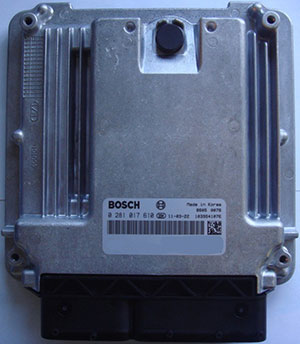
 Type: Bosch
Fits: VAG – Audi / Seat / Skoda / Volkswagen (VW)
Fuel: Diesel
Ref: ECUT339325
Note: This ECU may also fit other models.
Everything a failing Bosch EDC17CP20 puts in front of a technician points away from the ECU. The unit meters fuel and drives the injectors on VAG 2.0 TDI diesels, so when its control of those injectors breaks down the vehicle reports a fuelling fault and names the parts around it: a warning lamp, the loom, the rail sensor, the injectors themselves. This page sets out what that evidence looks like, why every part it accuses tests sound, and which link is left. It is a diesel engine ECU, and one that arrives here is tested end to end and rebuilt rather than swapped.
The warning lamp names a part that is fine
On the Transporter T5 the first sign is usually a flashing glow-plug light. On a diesel of this generation that lamp is the general engine-management warning, not a message about the glow plugs — and nothing has gone wrong with them.
It is still the first thing the driver reads, and the first thing repeated to a garage. A fault with nothing to do with pre-heating arrives described as a glow-plug problem.
The behaviour points at the fuel system
What comes with the lamp is a loss of power, an engine management light, or in the worst case no start at all. The module has stopped driving the injectors correctly, so fuel delivery is disrupted at source.
From the driver’s seat that is a fuelling fault, and from the first scan it is a fuelling fault too. Neither version separates an ECU that has stopped commanding the injectors from a failed injector, a damaged loom or a fuel-pressure problem — the engine behaves the same way whichever it is.
The parts that get changed first
Published fault descriptions for this unit are blunt about where that leads: these symptoms are often misdiagnosed as damaged wiring, a faulty fuel rail pressure sensor, or the injectors.
That is not carelessness; it is the diagnostic path working as intended. Each of those parts is accessible, each has a specification to be measured against, and each can be tested on the vehicle. Presented with a fuelling complaint, a technician tests the fuelling components — and on these vans they routinely come back sound.
The one link that cannot be measured in place
Work along that chain and it ends at the ECU’s own injector output stage — the drive circuitry inside the sealed module that switches the injectors.
That stage cannot be checked the way a loom or a sensor can. In the vehicle it can only be judged by what it puts out, and if it has degraded rather than died, producing a signal that is present but not right, a reading at the connector settles nothing. So it is suspected last, after everything measurable has been cleared — and on this unit it is frequently the answer.
The evidence is not misleading by accident: it is produced by the one part sitting beyond where the evidence can be read.
What is published against these part numbers
Two UK specialists with no reason to agree publish a fault against the numbers on this page, and it is the same fault.
One lists exactly one common problem against 03L 907 309 K, the number in the table below, and the identical entry against the sibling number 03L 906 022 CD: no injector signal. The other describes the same mechanism from the other end — the unit failing to activate the injectors, and the non-start that follows on the T5.
Two separate records, reached independently, land on the same output stage on the same hardware. That is not proof about any one unit; it is a statement of what these do when they fail.
Why the failure develops
The internal components degrade under heat and electrical stress in ordinary service; that is the documented cause of failure here.
A replacement unit contains the same components and goes into the same engine bay. Fitting one deals with the symptom without dealing with what produced it. Repairing the original addresses the components that have actually degraded, and the unit keeps the coding and immobiliser pairing it already holds, so nothing needs programming back to the vehicle.
The part number on this page
0281016272, Volkswagen’s 03L 907 309 K, is the number in the table below. It is a 2.0 TDI application, documented on the Transporter T5 (2009–2015) and the first-generation Amarok (2010–2012).
The EDC17CP20 was built in several software variants across VAG 2.0 TDI engines; the one used on these applications is designated EDC17CP20-2.7. If the number on your unit is not the one in the table, it may still be one we take: the Volkswagen page these are grouped under lists the rest, alongside the makes we repair engine ECUs for.
What happens to a unit that is sent in
A unit is booked in, inspected, and put under power on the bench before any conclusion is drawn. You are told what the testing found and what the repair involves; nothing chargeable happens until you have authorised it.
Component-level repair is what happens after that: our own engineers, in our own UK workshop, working on the board that came out of the van. Final testing has to pass before anything goes back, and the fault we fix carries 24 months of warranty cover. Remapping, tuning, cloning and immobiliser work are not part of this service.
The van stays where it is; only the ECU travels, and it reaches us by post from anywhere in the UK. What starts a test here is the Repair Form, and the detail worth putting on it is what the lamp was doing and how the engine behaved when it stopped.
Common part numbers associated with this type of unit
| Bosch Number | OEM Number | Price | Warranty |
|---|---|---|---|
| 0281016272 | 03L 907 309 K | £POA | 24 months |
2 Replies to “VW / Audi / Seat / Skoda (VAG) Bosch EDC17CP20 Engine ECU Repairs”
Leave a Reply
Related Posts
VW / Audi / Seat / Skoda (VAG) Magneti Marelli 4HV Engine ECU Repairs
Type: Magneti Marelli Fits: VAG – Audi / Seat / Skoda /…
Magneti Marelli IAW4MV Engine ECU Repairs
Type: Magneti Marelli Engine Management Fits: Audi A2 / Seat Corboda…
Rover Lucas 10CU Engine ECU Repairs
Type: Lucas Fits: Rover Fuel: Petrol Ref: ECUT130150 Note: This ECU may also…
Are you able to over-ride the immobiliser on a 2009 Audi Q5, 3.0TDI ECU:
P/No.-8R0 907 401J
My original is unserviceable due to “cowboys” in the industry and, as such, I have purchased an identical s/hand ECU from a similar Audi with the same drive train.
The VIN is also required to be re-written.
Thanks,
Wayne Hills, Adelaide, South Australia
Hello Wayne
Yes we are able to remove the immobiliser from this ECU but also if you send your original ECU to us, we may be able to transfer the immobiliser coding into the new ECU for you so that we can keep the immobiliser active and working on your vehicle.
Kind Regards
Jason
ECU REPAIRS