
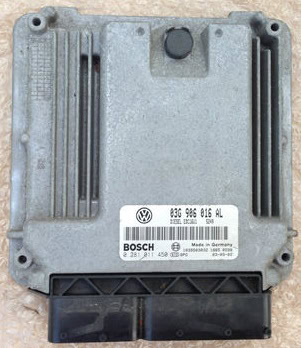
 Type: Bosch
Fits: VAG – Audi / Seat / Skoda / Volkswagen (VW)
Fuel: Diesel
Ref: ECUT336295
Note: This ECU may also fit other models.
An accelerator pedal on one of these engines asks the ECU for torque, not for fuel. The EDC16U31 decides the fuelling itself, working from a model fed by every input it has, and it then checks its own answer, comparing what it commanded against what those inputs say the engine actually did. It is a diesel engine ECU, and both halves of the job, the testing and the rebuild, happen in our own workshop.
Why a failing unit slows the car instead of stopping it
When that check fails, the designed response is to reduce, not to shut down. The unit has decided it can no longer account for what the engine is doing, and the safe response to that is to give it less. So a failing EDC16U31 does not usually strand anyone. It hands back less than was asked for, and it carries on running.
Reducing is the right answer to an input that cannot be verified, and on a healthy unit with a genuinely failing sensor it is exactly the behaviour you want. The problem starts when the fault is inside the unit doing the checking. The reduction still happens, it still feels the same from the driver’s seat, and nothing announces where the decision came from.
What that looks like from the driver’s seat
The car is flat, then it is fine. It goes soft halfway up a hill and is back to normal once it has been switched off and started again. Nothing fails, nobody is left at the roadside, and there is no single event to point at.
That is why these get lived with. A vehicle that is down on power but still does everything asked of it reads as a tired engine, a tired turbocharger, or simply age, and most people adjust to it rather than chase it. The complaint that eventually arrives is not that something broke, but that the car is not what it was.
Why the codes point at everything except the ECU
Because the ECU reduces power deliberately, what it stores describes the decision it took rather than the condition of the thing that took it. The record names the input it disbelieved. So a scan comes back pointing at a sensor, and a sensor is a real component with a name and a location, which makes it the obvious thing to change.
Then the pattern sets in. The named part goes on, the car is briefly better or no different at all, and a few weeks later the same behaviour returns. Another part goes on. Nothing that was changed was ever wrong, which is why these cars accumulate a history of replaced parts and no explanation.
A unit that still starts the car can still be the fault
None of this can be settled by whether the engine runs. It starts, it idles, it drives, and on a good day it drives normally. A unit behaving this way passes every test that amounts to turning the key.
What it will not pass is being worked through its range and watched. On test equipment that powers it and feeds it the inputs it expects, the unit can be taken through the load and speed it would meet on the road and held there. The point of interest is where it begins pulling back, and whether it does so repeatably. That is a measurement rather than an opinion, and it is the case for testing a unit instead of guessing at it.
Units do also fail outright, and a vehicle that will not start at all is the easier case to recognise. Repair is the whole of what happens to a unit here; we do not remap or retune anything.
U1, U31 and U34 are not the same computer
They are different computers, not one unit wearing three labels. The EDC16U1 runs an MPC555 processor with a megabyte of flash. The EDC16U31 and the EDC16U34 run the later MPC564, with two megabytes. Different processor, different memory, different part.
Which is why “EDC16” on its own does not tell you which unit you are looking at. These three are not the same part, so the number on the label is what matters when one is sent in. The EDC16U1 in the same VAG family answers the pedal exactly as this one does, and it is dealt with on a page of its own.
What happens to a unit that arrives here
None of this changes with the badge. The unit is listed here against four VAG marques, so a Skoda owner reading a heading that opens with VW and Audi could reasonably decide the page is not about their car. It is, and the other units under that marque sit in Skoda’s own group.
Every unit gets its own record when it arrives, a physical inspection, then power and a full electrical test before anyone says anything about it. You are told what was found and what putting it right involves, and nothing chargeable happens until you have approved it. Repairs are made at component level on your own board, by our engineers, in our own UK workshop, and tested again before packing. The repair carries a 24-month warranty.
The useful detail is when the power drops away and whether a restart returns it, because that is the behaviour a bench test is set up to reproduce. Describing it is what the Repair Form is for, and units reach us by post from every part of the UK.
Common part numbers associated with this type of unit
| Bosch Number | OEM Number | Price | Warranty |
|---|---|---|---|
| 0281011850 | 03G 906 016 BF | £POA | 24 months |
| 0281012113 | 03G 906 016 GN | £POA | 24 months |
| 0281012127 | 03G 906 016 FE | £POA | 24 months |
| 0281012267 | 03G 906 016 CL | £POA | 24 months |
| 0281012538 | 038 906 016 AJ | £POA | 24 months |
| 0281012557 | 03G 906 016 HS | £POA | 24 months |
| 0281012654 | 03G 906 016 JP | £POA | 24 months |
| 0281012697 | 03G 906 016 JN | £POA | 24 months |
| 0281012723 | 03G 906 016 JA | £POA | 24 months |
| 0281012762 | 038 906 016 AH | £POA | 24 months |
| 0281013292 | 03G 906 016 KP | £POA | 24 months |
| 0281013293 | 03G 906 016 KN | £POA | 24 months |
| 0281013302 | 070 906 016 DE | £POA | 24 months |
| 0281013888 | 03G 906 016 LR | £POA | 24 months |
| 0281014050 | 070 997 016 M | £POA | 24 months |
| 0281014104 | 03G 906 016 MC | £POA | 24 months |
| 0281014150 | 03G 906 016 MD | £POA | 24 months |
| 0281014252 | 070 906 016 DS | £POA | 24 months |
| 0281014253 | 070 906 016 DQ | £POA | 24 months |
| 0281014261 | 03G 906 016 MH | £POA | 24 months |
| 0281014893 | 070 906 016 EC | £POA | 24 months |
Related Posts
Bosch DME M 1.7.3 Engine ECU Repairs
Type: Bosch Engine Management Fits: BMW 316i / 318i /…
Timing Belt Replacement: When and How to Replace the Timing Belt
The timing belt is crucial in any vehicle. Since your…
Ford Visteon EECV LPE-301 Engine ECU Repairs
Type: Visteon Engine Management Fits: Ford Engines: Year: Fuel: Petrol Ref: ECUT56175 Note:…