
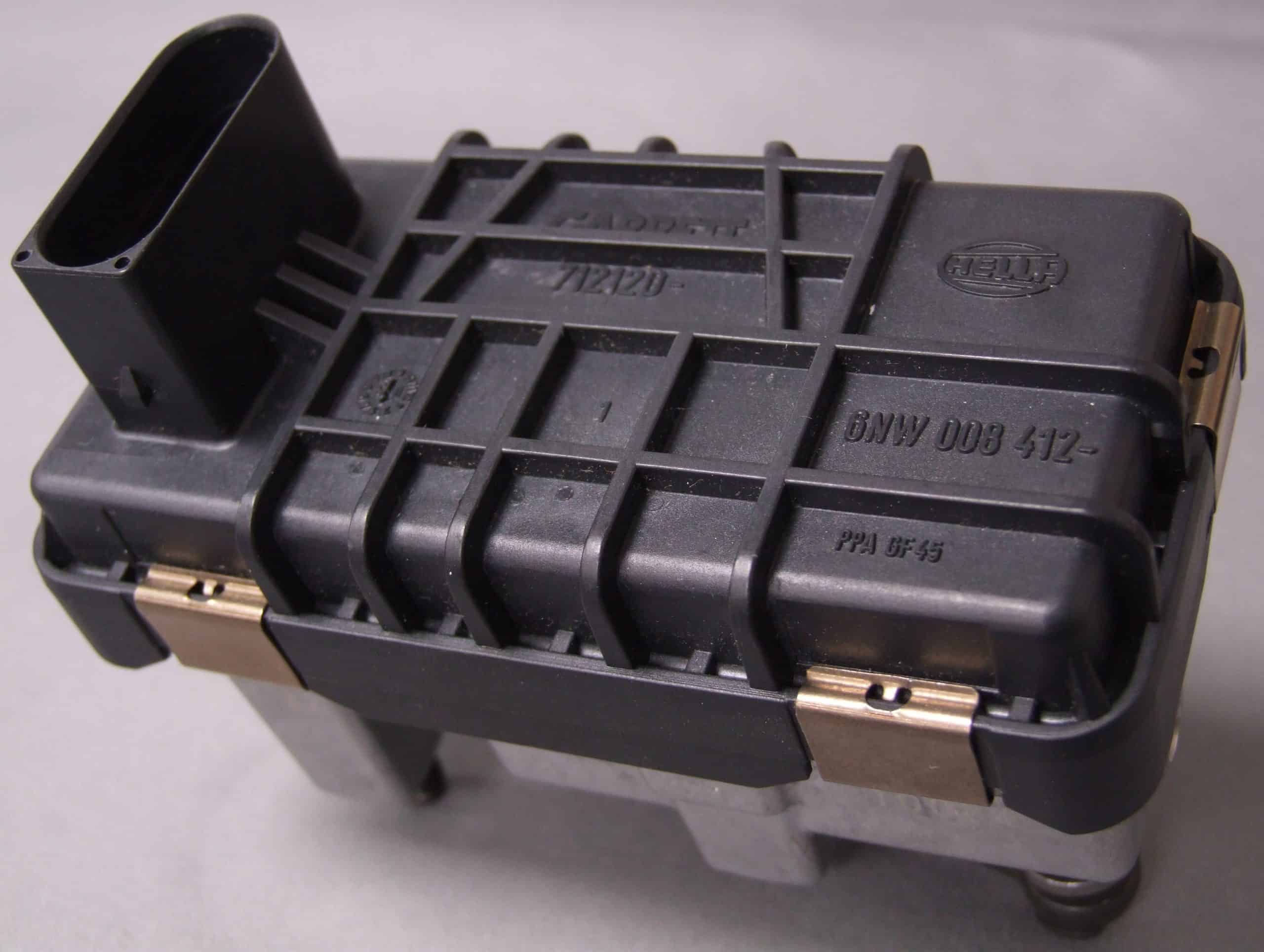
An electronic turbo actuator is the small motorised unit that sets turbocharger boost to a target chosen by the engine management system. When it stops doing that reliably, the car loses power, slips into limp mode and stores a boost-related fault code. What the code almost never tells you is the one thing that matters: whether the actuator itself has failed, or whether the electronics commanding it have. Those are two entirely different repairs, and only one of them involves the actuator at all.
Below we set out the symptoms and fault codes an owner or garage actually sees, how to test an electronic turbo actuator properly rather than by guesswork, and – the part no other guide covers – how to separate a genuine actuator-hardware failure from an ECU-side control fault. Get that distinction right and you stop replacing parts that were never broken.
What an electronic turbo actuator does, and why the ECU is in charge
On a modern turbocharged engine, boost is not left to a spring and a pressure hose. A variable-geometry or electronic wastegate actuator moves the vanes or the valve to a precise position, and that position is decided electronically. The target boost is calculated by the engine control unit (ECU) software, converted into a position command, and sent to the actuator many times a second. A position sensor inside the actuator reports back where it actually is, and the ECU trims the command until commanded and actual position agree.
That feedback loop is the key to the whole fault. The actuator is a motor, a small gear train and a position sensor. The ECU is the part that drives that motor, reads that sensor, and holds the learned adaptation that maps a boost target to a physical position. A problem anywhere in the loop surfaces as the same handful of symptoms, which is exactly why so-called turbo actuator faults are misread so often.
Symptoms of a faulty electronic turbo actuator
The symptoms are consistent across makes because the consequence of a boost-control fault is always the same: the engine either cannot make its boost, or cannot control it. Watch for:
- Noticeable power loss or turbo lag, most obvious low down and through the mid range
- Limp mode – the ECU caps power to protect the engine, often clearing on a restart then returning under load
- A check engine light with an underboost (P0299) or overboost (P0234) code stored
- Boost that surges or hunts up and down instead of holding steady
- Slow or inconsistent throttle response
- Black smoke on a diesel, from fuelling that no longer matches the air the turbo is delivering
- A whistle, whine or rattle from the turbo area if a vane or linkage is sticking
None of these tells you where the fault sits. Power loss with an underboost code is the single most common presentation, and it is caused just as readily by an ECU that cannot drive the actuator as by an actuator that will not move. The next two sections are about telling those apart.
Electronic turbo actuator diagnostic table
This is how to move from a symptom to the side of the system that has actually failed. In almost every case the deciding test is the same: command the actuator and watch whether it responds.
| Symptom or fault | Points to actuator hardware when | Points to an ECU-side fault when | Next check |
|---|---|---|---|
| Underboost, limp mode (P0299) | The actuator will not move when commanded, or moves stiffly and stalls part-way | The actuator moves freely by hand or on the bench, but the ECU never drives it | Run a scan-tool actuation test and watch the position feedback follow the command |
| Overboost (P0234) | The vanes or wastegate are stuck closed, or the actuator is seized | The driver output is stuck on, or the boost adaptation is corrupted | Compare commanded position against actual boost in live data |
| Position sensor circuit code (P2563 to P2565) | The actuator’s internal position sensor has failed | The supply or signal return the ECU provides to that sensor has failed, or the wiring between them has | Back-probe the sensor supply, ground and signal at the actuator connector |
| Actuator does nothing, no self-test sweep at key-on | The motor is open-circuit or mechanically seized | The ECU’s output stage is not energising the motor | Measure the drive voltage at the actuator’s motor terminals during the key-on sweep |
| Same fault returns after a new or reconditioned actuator is fitted | Rarely the cause – a new part is unlikely to fail identically | A strong sign the ECU’s actuator driver, or its stored adaptation, is the fault | Bench-test the ECU’s actuator driver output, then reset and relearn the adaptation |
| Intermittent limp mode that clears on restart | A corroded or loose connector at the actuator | A dry joint or a failing driver on the ECU board that misbehaves once warm | Wiggle-test the harness and connector; if those are clean, the intermittent points inboard to the ECU |
Turbo actuator fault codes and what they point to
Like all OBD-II codes, these describe the electrical or pressure behaviour the ECU has observed – not the part that caused it. Read carefully they narrow the search; taken as an instruction to replace a part, they mislead.
| Code | Description | What it points to |
|---|---|---|
| P0299 | Turbocharger / supercharger underboost condition | The commonest of the set. Boost is below target. Can be a sticking actuator, an ECU that is not driving it, or a genuine plumbing leak – a symptom code, not a diagnosis |
| P0234 | Turbocharger / supercharger overboost condition | Boost above target. Vanes or wastegate stuck closed, or the control loop failing to back the actuator off |
| P0045 to P0048 | Turbo boost control ‘A’ circuit – open / range / low / high | The control circuit the ECU uses to drive the actuator. The low and high-input versions frequently sit on the ECU’s driver output or the wiring, not on the actuator |
| P2563 to P2565 | Turbocharger boost control position sensor circuit – range / low / high | The actuator’s position-feedback signal. A failed internal sensor, or a failed supply or return from the ECU that reads it |
| P2262 | Turbo boost pressure not detected – mechanical | Points away from the electronics toward a mechanical or plumbing fault – a stuck mechanism, a leak, or a failed turbo |
The pattern worth remembering: the position-sensor and drive-circuit codes, P2563 to P2565 and P0045 to P0048, are the ones that can sit on either the actuator or the ECU – and they are exactly the ones people answer by fitting an actuator that changes nothing.
How to test an electronic turbo actuator
You can get most of the way with a scan tool, and the rest with a multimeter. Exact voltages and whether an active test is available vary by manufacturer, so check the vehicle’s service data first. The method below is about the pattern of behaviour, which is what actually tells you whether the actuator is doing its job.
- Read and record the codes first. Note everything stored, not just the boost code, and do not clear them – what else is present is evidence.
- Run the scan-tool actuation (active) test if the vehicle supports one. Command the actuator through its range and watch the position feedback follow. Smooth tracking means the motor, gears and sensor are healthy and the ECU is driving them.
- Watch the key-on self-test. Many electronic actuators perform a short sweep when the ignition is switched on; a missing sweep points at the motor or its drive.
- Check the position sensor circuit with a multimeter. Back-probe the connector: confirm the reference supply is present, the ground is clean, and the signal moves smoothly through its range as the actuator moves.
- Check the motor drive. Measure the voltage the ECU delivers to the actuator’s motor terminals during a commanded move. No drive reaching a healthy motor puts the fault inside the ECU.
- Road-test with live data, comparing commanded boost against actual boost. A gap that opens up under load, while the actuator is being commanded correctly, confirms the control side is trying but the boost is not arriving.
Actuator hardware or ECU-side fault – and where each one belongs
By this point the tests have usually split the problem cleanly in two, and the two halves go to two different places.
If the actuator itself has failed – a seized motor, a worn gear train, a dead internal position sensor, a linkage sticking with carbon – that is turbo-hardware work. It means reconditioning or replacing the actuator, and it belongs with a turbocharger specialist. It is not something we do, and it is worth being told so plainly rather than being sold a service that does not fit the fault.
If the actuator is sound but the electronics commanding it are not – a failed driver or output stage that cannot energise the motor, a corrupted or mis-learned boost adaptation, a collapsed supply to the position sensor, a dry joint that only lets go once the board warms up – that is a fault inside the engine ECU, and it is exactly what we repair. We work on engine ECUs, ECMs and PCMs only, down to component level, on our own benches and by our own engineers here in the UK, confirming an ECU-side actuator fault by driving the output stage directly on the bench rather than inferring it from the car’s own codes.
Because the repair fixes the component that failed instead of swapping the unit, the ECU keeps the coding and immobiliser data already on it and refits to your vehicle without programming. It runs as a mail-in service across the whole UK: the unit is tested and diagnosed first, you are told what has failed before anything chargeable begins, and the repair carried out is covered by a 24-month warranty. If your diagnosis has pointed past the actuator to the ECU driving it, complete the Repair Form and our engineers will confirm coverage and diagnose the unit.
Frequently asked questions
What happens when the turbo actuator goes bad?
The engine loses the ability to make or control boost, so you get power loss or turbo lag, often limp mode, and a stored underboost or overboost code. Boost may surge or hunt rather than hold steady. The same symptoms appear whether the actuator itself has failed or the ECU commanding it has, so the presentation alone will not tell you which repair you need – a scan-tool actuation test will.
How much does it cost to fix a turbo actuator?
It depends entirely on which fault you have, which is why testing before buying anything matters. A failed actuator is turbo-hardware work handled by a turbocharger specialist. Where the fault is on the ECU side – a failed driver stage or a corrupted adaptation – it is a component-level engine ECU repair; we diagnose the unit first and tell you what has failed and what the repair involves before any chargeable work starts. Replacing an actuator that was never the problem is the route that costs most, and it is the common one.
How do you test an electronic turbo actuator?
Read the codes first without clearing them, then run a scan-tool actuation test and watch the position feedback follow the command – smooth tracking means the actuator and its wiring are healthy. Back-probe the connector with a multimeter to confirm the position sensor has its supply, ground and a signal that moves through range, and measure the drive voltage the ECU sends to the motor during a commanded move. No drive reaching a healthy motor points the fault back to the ECU.
Can you drive with a faulty actuator?
It is not advisable. In limp mode the car is down on power and unpredictable when you need to accelerate, and uncontrolled boost – an overboost fault in particular – risks further damage to the turbo and engine. The car will usually still move, but the sensible step is to diagnose the fault promptly rather than keep driving on it.
Related Posts
Siemens 3PE/3PG Engine ECU Repairs
Type: Siemens Engine Management Fits: Audi A3 / Seat Ibiza / Volkswagen…
Citroen / Peugeot Siemens SID801A Engine ECU Repairs
Type: Siemens Engine Management Fits: Citroen / Peugeot Fuel: Diesel Ref: ECUT245250 Note:…
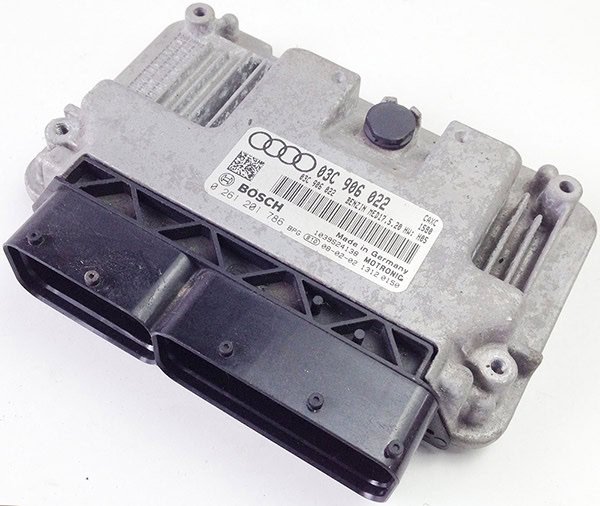
VW / Audi / Seat / Skoda (VAG) Bosch MED 17.5.20 Engine ECU Repairs
Type: Bosch Engine Management Fits: VAG – Audi / Seat / Skoda…