
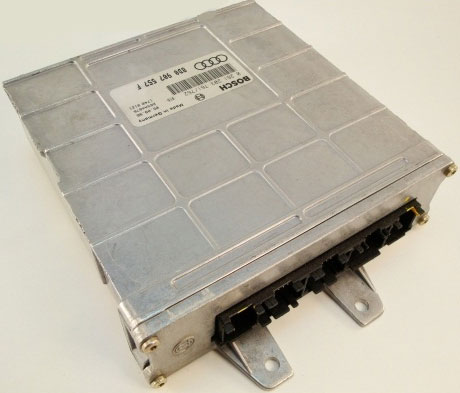
 Type: Bosch Engine Management
Fits: VAG – Audi / Seat / Skoda / Volkswagen (VW)
Fuel: Petrol
Ref: ECUT182195
Note: This ECU may also fit other models.
A Bosch M3.2.1 lifted out of an Audi A6 cannot be judged entirely on its own, and the two faults on public record against it are the reason. They are not two versions of the same problem. One is a failure of the board; the other is not a failure at all.
The two Bosch numbers on the table below, 0261203761 and 0261203762, are one control unit and not two. Every source that carries either prints both, as a pair, against the single Audi reference 8D0 907 557 F — which is what the blank second cell means. This page covers what is on record against the unit, why the two documented faults pull in opposite directions, and what car it belongs to.
Two faults on record, and only one of them is a fault on the board
The published record against this unit is short and specific. One entry is a fault published as 17978 / 463A / P1570, with a three-word description: motor ECU locked. The other is the absence of any actuation of the ignition output stage — the part of the board that switches the ignition coils — on one or more cylinders.
Those two entries describe entirely different situations. A locked module is not a broken one: the board can be electrically sound throughout and still refuse to let the engine run, because what has not been satisfied is the security relationship between the unit and the car it was coded to. An ignition output stage that has stopped firing is the opposite case — a physical failure on the board, in a part of it that does real work every time the engine turns.
From the driver’s seat the two can present identically. The engine cranks and will not run, or it runs on fewer cylinders than it has. The complaint is the same either way, and it says nothing about which of the two produced it. That ambiguity belongs to this arrangement in particular; a broader look at Audi ECU faults deals with the symptoms that recur across Audi engine management.
Why fitting another one is not a test
The obvious next step, once a unit is suspected, is to borrow another and try it. On this generation that does not do the job it is asked to do.
A second-hand M3.2.1 arrives already paired to whichever car it was taken out of. Fitting it to another A6 adds a second unknown of exactly the same kind as the first, and if the engine still will not run, nothing has been established — a locked unit and a failed unit behave alike from the outside. A UK remanufacturer listing Audi Motronic units of this era prints one word of technical note against them: Immobilised.
A specialist repairer that publishes fault records for this exact unit asks for the car’s immobiliser control module before it will check and repair one. Between them, the two notes describe a device whose correct behaviour is only fully visible in company.
What repairing the original unit protects
Repairing the board that came out of the car steps around the question altogether. The unit that goes back is the one the car was coded to, so the coding and the immobiliser pairing are still the ones it expects — not because they have been re-established, but because they were never disturbed.
The work is done here. Our own engineers repair every unit, in our own UK workshop, on our own equipment, with nothing handed to a third party. Every unit that arrives is recorded, examined by eye, then powered up and measured; the diagnosis comes after that rather than before it. Where the fault is on the board, the failed part is identified and renewed under a microscope, with rework equipment suited to how a unit of this construction was assembled.
The result of that testing is reported to you first, and no chargeable work is authorised by anyone but you. The repair itself is guaranteed for 24 months.
If what you are after is immobiliser removal, cloning, remapping or a tuning file, that is not what happens here. The board comes back as the board it was.
The Audi this unit was built for
The application on record for 0261203761 and 0261203762 is the Audi A6 of the C4 generation, type 4A, with the 1.8-litre 20-valve petrol engine, code ADR, 92 kW, built between 1995 and 1997. That is the car the pair is documented against, by the sources that carry the Bosch numbers and the Audi reference together.
The note above the table holds here: a unit of this type may be fitted to models beyond the one named, and it is the number on the label that decides. A list of which Audi engine ECUs we repair sits elsewhere on the site, for a number that turns out not to be one of these two.
Posting a unit to us
This is a postal service, the same from any address in the UK: the unit comes to us, is dealt with, and goes back.
When one of these is sent in, it helps to describe the symptom on the Repair Form in plain terms — what the engine does when the key is turned, whether it does the same thing every attempt, and whether anything else was done to the car shortly before the trouble began. With these two faults on the record, that account earns its keep.
Common part numbers associated with this type of unit
| Bosch Number | OEM Number | Price | Warranty |
|---|---|---|---|
| 0261203761 | 8D0 907 557 F | £POA | 24 Months |
| 0261203762 | £POA | 24 Months |
Related Posts
VW / Audi / Seat / Skoda (VAG) Bosch EDC15P Engine ECU Repairs
Type: Bosch Fits: VAG – Audi / Seat / Skoda / Volkswagen…
VW / Audi / Seat / Skoda (VAG) Siemens Digifant Engine ECU Repairs
Type: Siemens Fits: VAG – Audi / Seat / Skoda / Volkswagen…