
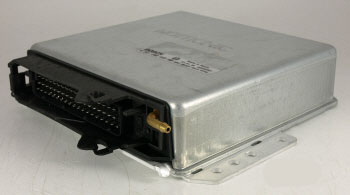
 Type: Bosch Engine Management
Fits: VAG – Audi / Seat / Skoda / Volkswagen (VW)
Fuel: Petrol
Ref: ECUT178195
Note: This ECU may also fit other models.
Bosch built the M2.3 and its M2.3.2 revision in the years between the late 1980s and the late 1990s, so every one of these units still fitted to a car has upwards of thirty years of running behind it. On a board of that age, asking which single component failed is the wrong starting point, because the parts around it have exactly the same history. This page sets out what that history does to a board, what the documented failures of these units show, and what a repair carried out to the right scope actually covers. It is a petrol engine ECU, and the work on it is done here at component level.
What a working life of that length does to a board
Consider what the board has actually been through. Every time the engine ran, the board warmed through; every time the car was parked, it cooled again, and the joints holding the components in place have taken that movement on every one of those occasions. The output stages have switched for every spark and every injection the engine has ever made.
None of that breaks anything on a particular day. It uses the hardware up, gradually and fairly evenly, because the parts that share a board also share its history — the same heat, the same hours, the same work. Wear of that kind does not single anything out. It brings a whole population of components towards the same point at roughly the same time.
What the failures documented against these units show
Three cases recorded against these units are more useful than any general account. In the first, an ABY-engined car lost its ECU while cruising at around 60 mph, with no warning beforehand. In the second, a mechanic handed one of these units as a broken part opened it and found transistors already dead inside. In the third, a car cranked with no spark and no injector operation at all, while the fuel pump still pressurised normally.
Taken one at a time, those are three different faults. Taken together, they are one thing. None of them describes a component that was defective from the start; they describe boards that had run out of margin, on cars that had given no notice. The wearing out is gradual. The failure is not.
Why replacing the one failed part is the wrong scope
Find the dead transistor on a board like this, fit a new one, and there is a fair chance the unit runs again. The difficulty is what that new part is then surrounded by. Every other component of the same age has sat through the same heat, carried the same load and accumulated the same hours, and the one that gave way first was not necessarily the weakest by much.
So the component that stopped is not the job. It is the evidence. What it tells you is where the board as a whole has got to, and the work that follows from that is renewal of the aged parts as a group — the ones whose condition is a matter of hours run rather than bad luck — rather than one substitution and a hope.
What component-level renewal involves
Nothing is touched until the unit has been powered up on the bench and the whole board assessed, rather than just the area around the visible failure. That assessment decides the extent of the work, and on a unit of this age it reaches further than the fault that brought it in.
The work itself is carried out under a microscope, with rework equipment suited to boards built this way, by our own engineers in our own workshop. The board that goes back into the car is the one that came out of it, with its aged parts renewed rather than its fault patched.
The part numbers documented for this unit
Both Bosch numbers in the table below are documented against Audi 20V turbo petrol cars.
- 0261200465 / 4A0 907 551 AA — the Audi S4 and S6 of the C4 generation, 2.2 20V turbo, 230 hp, with the AAN and ABY engines.
- 0261200484 / 895 907 404 — the Audi Coupé S2 quattro, ABY 2.2 20V turbo, built between 1992 and 1997. The number also appears as 895 907 404 BA.
Both documented applications carry an Audi badge, which is why this unit sits with the rest of the Audi engine ECU repairs we handle. If the car in front of you is a later Audi and this designation is not the one you are looking at, the faults that recur across Audi engine ECUs are covered separately. A number other than these two may still be an M2.3 or M2.3.2 unit we can work on; more part numbers exist for this type than have a documented car against them.
Sending a unit in
A unit that arrives here is logged, inspected and tested under power before anyone offers an opinion on it. What the testing found goes back to you with what the repair would involve, and nothing chargeable starts until you have agreed to it.
The repair is component-level work on your own board, and it is warranted for 24 months. Repair is the whole of what we do with these units: no remapping, no tuning, no chipping, no cloning and no immobiliser work.
Only the ECU needs to travel, from anywhere in the UK. A unit is booked in through the Repair Form, which asks for the Bosch number off the label and what the car was doing when it stopped.
Common part numbers associated with this type of unit
| Bosch Number | OEM Number | Price | Warranty |
|---|---|---|---|
| 0261200465 | 4A0 907 551 AA | £POA | 24 Months |
| 0261200484 | 895 907 404 | £POA | 24 Months |
Related Posts
VW / Audi / Seat / Skoda (VAG) Bosch MP4.0 Engine ECU Repairs
Type: Bosch Engine Management Fits: VAG – Audi / Seat / Skoda…
The Evolution of Ford ECUs: From Carburetors to Cutting-Edge Control Systems
The Evolution of Electronic Control Units (ECUs) in Ford vehicles…
Mercedes Bosch EDC15C6 Engine ECU Repairs
Type: Bosch Engine Management Fits: Mercedes-Benz Fuel: Diesel Ref: ECUT81250 Note: This ECU…