
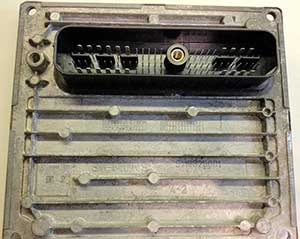
 The Siemens SIM210 engine ECU from this petrol Ford Fiesta 1.25 had been spiked. Our testing confirmed as much. What caused it is another matter: the record of the job offers a possible cause, not a proven one, and the two are worth keeping apart.
From a car left standing to a garage diagnosis
The car had been left standing for two months. When the customer went to jump start it, it did not start.
A local garage diagnosed the fault as a faulty ECM. The engine did not crank at all. The customer then sent the unit to our workshop to be tested and repaired.
The whole service runs by post, for owners and garages anywhere in the UK.
What bench testing confirmed
The garage had pointed at the engine ECU. Our bench’s job was to confirm that diagnosis or overturn it, and testing confirmed it: the unit was faulty. A garage diagnosis tells you where to look; bench testing of the unit itself is what settles it.
Testing also found that the unit had been spiked, which is to say it had taken a voltage spike.
Every unit that arrives is logged and checked by eye, then tested electrically, and the diagnostics that follow are built around the symptom the car presented. The customer hears the findings first, and nothing is repaired without their go-ahead.
What the record can say about the cause
The damage was a test result. The cause was not. The record gives the jump start as the possible source of the spike and names three ways it could have happened:
- jump starting the car without surge protection
- the cables touching
- the cables fitted the wrong way round
Which of those happened, if any did, is not in the record. So the jump start stays where the record put it, as a possibility.
What the job does show is an order of events: two months standing, a jump start, no start, then a garage diagnosis. The ECU enters the story at the jump start, because that is where the record places the possible cause. It is one Fiesta’s sequence, not a rule about cars that have been parked.
A repair judged by the test rig
We repaired the unit. Our component-level repairs are carried out under a microscope, on temperature-controlled rework equipment, and a repair counts as finished only once the unit passes final testing.
This one passed on our test rig. The repair is covered by our 24-month warranty.
The D at the end of both numbers
6S61-12A650-FD is a Siemens SIM210 unit. Sixteen of the sources we checked print it with the Siemens number S120977315 D, and eleven print the four-character code 2CJD after the Ford number. It is on record from the Ford Fiesta.
Our own Siemens SIM210 page that carries this unit’s row gives it as 6S6112A650FD 2CJD, with S120977315 D alongside.
When you check a label, look for the D at the end of both numbers. FD sits in that table beside FF and FH; all three share the same Siemens root, so the suffix letters are what tell them apart. A label that differs from this one in either suffix should not be matched to this page by eye; copy both numbers onto the Repair Form exactly as printed.
For a Ford with a different engine ECU, see our Ford page, for units other than the SIM210. For another manufacturer, see the makes whose engine ECUs we repair.
Where the label reads 6S61-12A650-FD, or a car would not crank after a jump start, the Repair Form is the place to tell us what happened before the car stopped starting. We test the unit once it arrives.
2 Replies to “Ford Fiesta 1.25 Petrol That Would Not Crank After Two Months Standing: Its Siemens SIM210 ECU (6S61-12A650-FD) Had Been Spiked”
Leave a Reply
Related Posts
Mercedes-Benz ML430 Bosch ECU 0261206303 With a Badly Soldered Chip and No Start
Our testing rig gave two verdicts on this Bosch engine…
Chrysler Voyager 2.5 CRD Voltage Fluctuating at Tickover: Bosch 0281010814 ECU Tested and Repaired
Nothing in the original complaint about this Chrysler Voyager 2.5…
BMW X3 2.0d That Would Not Rev: Two Faults in Its Bosch 0 281 013 501 ECU
Five volts should have been reaching the throttle position sensor.…
Hi I have a S120977010A which has had a voltage spike back to the ecu from the coil pack , how much for this to be fixed
Hello Jack!
Thanks for contacting us!
I’ve forwarded your enquiry to the concerned department & they will reach out to you via email.
Regards
ECU Repairs