
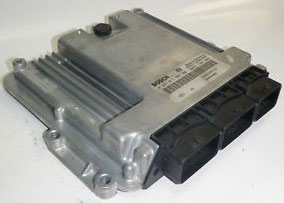
 Type: Bosch Engine Management
Fits: VAG – Audi / Seat / Skoda / Volkswagen (VW)
Fuel: Diesel
Ref: ECUT373325
Note: This ECU may also fit other models.
Plugging a scanner into a car with a suspect EDC17U01 puts the module in charge of its own examination. Live data, actuator tests and the stored faults themselves all reach the technician through the unit under suspicion. This page sets out how far a diagnostic session takes you on a small VAG diesel, what can be established from outside the module, and what changes once the unit is on a bench. It is a diesel engine ECU, and a unit of this type is tested under power and rebuilt at component level here.
Why a scanner cannot settle a question about the ECU itself
A diagnostic session is not an independent observation of the engine module; it is a conversation with it. The codes, the live values and the actuator tests all arrive down a link the module operates, in the form the module puts them in.
That is a perfectly good arrangement while the module is the thing you are asking with. It is a poor one when the module is the thing you are asking about, because the reply and the suspect share a channel, and the technician is standing at the wrong end of it.
What can still be established with the unit in the car
The list is short, and everything on it is worth doing first, because none of it depends on the module’s cooperation. Supply fuses can be checked. So can the feeds and earths at the ECU connector, measured there rather than assumed from a diagram, and the state of the connector itself — how the pins sit, whether the housing is seated, whether earlier work has disturbed anything.
Those checks are made from the outside, on instruments that answer to the technician rather than to the ECU. That is what makes them worth doing, and also why there are so few.
Where the in-car route runs out
Past those checks, what remains are questions about what the module is doing inside itself, and there is no route to an answer that does not pass through the module. Asking the module to account for itself is not a test; it is a request for a statement from the party under suspicion.
That is not a limit on the technician or the equipment — it is a limit built into where the equipment connects. A garage that has reached this point has done its job.
What a bench does that a vehicle cannot
On a bench the relationship is reversed. The unit is powered from a supply known to be good, so a marginal reading belongs to the unit rather than the car. Its inputs are generated deliberately — crank and cam signals produced to order — so what goes in is known rather than inferred.
Its outputs are put on real loads and read from outside on instruments of their own, so the module is no longer the one describing what it produced. The board is under observation while all of this is happening. And it can be held at temperature while it runs, so behaviour that only shows up when the unit is hot shows up here.
The unit stops being interviewed and starts being observed. That is the whole difference, and it is why a suspected EDC17U01 is settled off the car.
What Bosch publishes against this type
Bosch’s own repair service publishes error patterns against individual EDC17U01 part numbers. Against 0281013442, the Skoda Fabia 1.9 TDI unit, it publishes two lines: no communication with the ECU possible, error code reading not possible, and the engine does not start. The same two lines appear against 0281016733, a Seat application.
A UK repair specialist publishes the same pattern for the type as an internal fault, adding that the non-start can be permanent or temperature-dependent and that individual components stop being actuated.
Read that against everything above and it lands: the manufacturer’s own account of how this unit fails includes the loss of the channel a car would use to describe the failure. That is the argument for the bench, stated by the people who built the unit.
The part numbers documented for this unit
Bosch built the EDC17U01 for the smaller VAG diesel engines, and the documented applications are 1.4 TDI and 1.9 TDI cars across Skoda, Volkswagen and Seat.
- 0281015050 / 045 906 013 R — Skoda Fabia 1.4 TDI; the row in the table below.
- 0281014605 / 045 906 013 S — Volkswagen Polo 1.4 TDI.
- 0281013182 / 045 906 013 A — Skoda Praktik and Roomster 1.4 TDI.
- 0281013442 / 03G 906 013 M — Skoda Fabia and Fabia Combi 1.9 TDI, 77 kW, 2007–2010.
- 0281015600 / 03G 906 013 P — Seat Ibiza 1.9 TDI.
- 0281016733 / 045 906 013 AM — a Seat application; the model is not published.
Three of the six documented applications are Skoda, and our Skoda engine ECU work goes a good deal wider than this one designation. The Ibiza takes a 1.9 TDI unit of this type, and Seat has an engine ECU section of its own. If the number on your unit is not one of the six above, it may still be an EDC17U01 we handle — the designation covers far more part numbers than have a documented vehicle against them.
Sending a unit in
A unit reaching this workshop is logged, inspected and run on the bench before anyone commits to an opinion. We come back to you with what the testing showed and what the repair would involve, and nothing chargeable starts until you say so.
The repair itself is component-level work on your own board, done by our own engineers on our own equipment, and it is covered for 24 months. This is repair only — no tuning, no remapping, no cloning, no immobiliser work.
Only the ECU travels, from anywhere in the UK. There is a Repair Form for sending one in, and what it asks for is the part number off the label and what has already been checked on the car.
Common part numbers associated with this type of unit
| Bosch Number | OE Number | Price | Warranty |
|---|---|---|---|
| 0281 015 050 | 045 906 013 R | £POA | 24 Months |
Related Posts
Citroen / Peugeot Bosch M1.3.1 Engine ECU Repairs
Type: Bosch Engine Management Fits: Citroen / Peugeot Fuel: Petrol Ref: ECUT91195 Note:…
The Importance of ECU Repair: Protecting Your Vehicle’s Performance and Efficiency
Your vehicle's performance and efficiency are largely governed by a…
Rover Lucas 16CU Engine ECU Repairs
Type: Lucas Fits: Rover Fuel: Petrol Ref: ECUT135175 Note: This ECU may also…