


On the first-generation Mercedes A-Class (W168) petrol models, the part usually called the air mass unit is more than a sensor. The hot-film air mass sensor and the engine ECU share one combined unit, so a fault that looks like a sensor problem can sit inside the engine control unit itself.
Below are the symptoms and fault codes on record with this unit, the faults that imitate it, and how to work out which one your car has before anything is replaced.
What the air mass unit is on a W168 petrol A-Class
On most cars the air mass sensor is a separate part in the intake. It tells the engine ECU how much air the engine is drawing in, and the ECU uses that reading, with others, to decide how much fuel to inject.
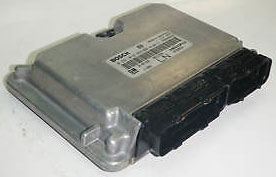
On the petrol W168 A-Class, the A140, A160 and A190 among them, those two jobs share one housing. The sensing element and the engine management electronics form a single assembly, so a failure on either side affects the whole unit.
That is why the usual advice for a suspected air-mass fault, to swap the sensor and see, does not carry over neatly to these cars. There is no separate sensor to swap: replacing the “sensor” means replacing the engine ECU. It also means that diagnosing the unit properly is engine ECU work, which is where it sits among the Mercedes engine ECU repairs we carry out.
Symptoms on record with the A-Class air mass unit
Owners and repairers report a consistent set of symptoms when this unit develops a fault. None of them belongs to the unit alone, which is why the sections after this one matter.
- Engine management light. Often the first sign, and for a while sometimes the only one.
- Rough or erratic idle. The engine runs lumpily or unevenly at rest.
- Loss of power, hesitation and flat spots. A delayed response when you press the accelerator, or a dip in pull as the revs rise.
- Starting problems. Hard starting, particularly from cold, and in some reports a car that will not start at all.
- Stalling or cutting out. The engine stops while the car is running.
- Poor fuel economy. Noticeably higher fuel use than the car normally returns.
- High emissions. A mixture that is out of balance shows up in the exhaust.
Fault codes stored with this unit
A diagnostic scan of an A-Class with an air-mass fault commonly turns up one or more of the codes below. Each describes what the engine ECU has detected, not which part has failed.
| Code | What it means in plain words |
|---|---|
| P0100 | A fault in the mass air flow circuit: the reading is missing or cannot be used. |
| P0101 | The mass air flow reading is outside the range the ECU expects, or does not agree with other readings. |
| P0102 / P0103 | The mass air flow signal is lower (P0102) or higher (P0103) than it should be. |
| P0170 | Mixture self-adaptation has reached its limit: the ECU has corrected the fuelling as far as it can and the mixture is still wrong. |
On a car with the combined unit, these codes carry an extra layer of doubt. The part reporting the fault and the part being reported on live in the same housing, so a stored P0100 can come from a failing sensing element, from the electronics that read it, or from something upstream such as an air leak.
Treat any of these codes as a starting point for diagnosis. None of them, on its own, proves that the unit has failed.
What to rule out before blaming the unit
Several simpler faults produce the same symptoms and codes, and each of them is reported as a source of misdiagnosis on these cars. Work through them first.
| Symptom or code | Can also be caused by | First check |
|---|---|---|
| Rough idle, stalling, management light | A dirty or contaminated throttle body | Inspect the throttle body for deposits and have it cleaned |
| Hesitation, P0101 or P0170, weak running | Air leaking into the intake | Check the intake hoses, joints and seals for splits or loose fittings |
| Codes and symptoms that come and go | Wiring and connector faults | Inspect the harness and plugs at the unit for corrosion, damage or poor contact |
| Mixture codes, high emissions, poor economy | A lambda (oxygen) sensor fault mistaken for an air-mass fault, or the reverse | Compare the live lambda data with the air-mass reading before condemning either |
The throttle body is a common cause of exactly the symptoms in the list above. Several accounts describe them clearing once it was cleaned, so it is worth doing before anything more drastic.
An intake air leak is easy to mistake for a bad air reading. Air that slips into the engine without passing the sensor is never measured, so the ECU fuels for less air than the engine is really getting, and the result looks very like a faulty air mass unit.
Wiring is the third suspect. A corroded pin or a damaged lead at the unit’s plug can produce intermittent codes that point straight at the unit when the unit itself is sound.
The lambda sensor and the air mass reading both feed the ECU’s mixture control, so a fault in one can make the other look wrong. A sound diagnosis reads both live, rather than relying on the stored codes alone.
Combined unit or separate sensor: which does your car have?
The combined unit belongs to the W168 petrol models. On the CDI diesel versions, such as the A 170 CDI, the air mass sensor is sold as a separate part in its own right. What this page says about the combined unit does not apply to later A-Class generations.
So the first question to settle is simple: is the air mass sensor on your car part of the engine ECU, or a separate part in the intake? Your garage, or a Mercedes parts counter working from the vehicle’s details, can confirm it.
If it turns out to be a separate sensor, the fault belongs with that sensor and a garage, not with an engine ECU repair. We work on engine ECUs only and do not repair, test or supply stand-alone air mass sensors. On the W168 petrol cars, the combined unit is an engine ECU, which is why it is something we repair.
Repairing the original unit or fitting a new one
When the combined unit is confirmed as the fault, there are two ways forward. A new replacement unit has to be coded and adapted to the individual car before it will run as it should.
Repairing the original unit avoids that step. It goes back onto the car it came from, already matched to it, and the repair deals with the specific fault inside it rather than exchanging the whole assembly.
How we repair the W168 combined unit
Because the combined unit is the engine ECU on these cars, our engineers repair it at component level in our own UK workshop, without outsourcing any of the work. The service is mail-in, so the unit is posted to us from wherever you are in the UK.
On arrival it is logged, inspected and electrically tested, then taken through diagnostics specific to the reported fault. We tell you what we found and wait for your go-ahead before any chargeable work begins.
Once repaired, the unit has to pass final testing before it is sent back to you. Your 24-month guarantee covers the precise fault we put right, and it belongs to you as the sender; it cannot move to whoever buys the car next.
One limit applies to this unit. We can repair it only when it comes from a manual-transmission A-Class, and we are unable to repair units from automatic A-Class cars.
Mercedes A-Class air mass unit FAQs
What are the common problems with a Mercedes mass airflow sensor?
On the W168 petrol A-Class, faults in the combined air mass unit are reported as an engine management light, rough idle, hesitation or loss of power, hard starting, stalling, poor economy and higher emissions, often with P0100, P0101, P0102, P0103 or P0170 stored. A dirty throttle body, intake air leaks, wiring faults and lambda sensor faults can produce the same signs, so rule those out first.
Can I still drive with a bad MAF sensor?
The car may still run, but an air-mass fault can cause hesitation and stalling, and a car that cuts out in traffic is a hazard. Driving on also leaves the underlying fault unresolved. Have it diagnosed promptly rather than relying on the car for long.
How do I reset the mass air flow sensor on a Mercedes?
The engine ECU holds learnt adaptation values, and a suitable diagnostic tool can clear them along with the stored codes. That can help after a genuine fix, such as a cleaned throttle body or a sealed air leak. If the fault is still there, the codes and symptoms come back, so clearing them is not a repair.
Where is the MAF sensor on a Mercedes?
On the first-generation (W168) petrol A-Class it is not a separate part: the air mass sensor is built into the combined unit that also houses the engine ECU. On other Mercedes models, including the A-Class CDI diesels, it is a separate sensor in the intake, and your garage can locate it on your car.
How much does it cost to fix an A-Class air mass fault?
It depends first on what has failed. A cleaned throttle body, a sealed leak or a repaired connector is a very different job from a fault inside the combined unit, which is why diagnosis comes before anything else.
Settle the simple causes, then look at the unit
On a W168 petrol A-Class, an air-mass fault can come from the throttle body, the intake, the wiring, the lambda sensor or the combined unit itself, and the symptoms alone will not say which. Clear the simple causes first, then look at the unit.
If the evidence points there and the car is a manual, send us your details through the Repair Form so our engineers can confirm coverage and diagnose your unit. For engine ECUs from other makers, start from our engine ECU repairs hub, and further units appear among the engine ECU types listed in What We Repair.
6 Replies to “Mercedes A-Class Air Mass Unit Problems: Symptoms, Codes and Checks”
Leave a Reply
Related Posts
VW / Audi / Seat / Skoda (VAG) Bosch EDC15P Engine ECU Repairs
Type: Bosch Fits: VAG – Audi / Seat / Skoda / Volkswagen…
All about Car Thermostat: Functions, Warning Signs, and Troubleshooting
The car thermostat is an essential element in regulating the…

Reasons Why Your Car isn’t Driving Smoothly
A smooth and comfortable ride is essential for any car…
Can you repair a semi automatics ecu?
Hello Roy
We do repair Semi-Auto ECU’s. For a quote, please provide the ECU part number and a brief description of the fault.
Kind Regards
Jason
ECU REPAIRS
What does it cost to make ECU and how long it takes.
Hello Claus
Thanks for the enquiry,
We’ve sent you a quick email with full pricing and repair information for the Mercedes A-Class Engine ECU.
Kind Regards
Jason
ECU REPAIRS
I appear to have the same ecu airmass problem, it’s a manual car. How much and how convenient? Please. Thanks
Hello Gary
Thank you for your enquiry,
We’ve sent you a quick email with full pricing and repair information.
Kind Regards
Jason
ECU REPAIRS